Signal, Not Noise
Perspective on marketing, growth, and what's actually changing. Ideas at the intersection of data, brand, and behavior. Thinking out loud about the future of customer growth.

October 2026
Single-Creator Bias: Why AI Bosses Need Personal Brands
The single-creator bias is a cognitive heuristic where people perceive complex work as higher quality, more intentional, and more trustworthy when attributed to a single visible creator rather than a collective committee. By personifying frontier technologies through an authentic founder narrative, tech leaders disarm System 1 threat detection, transforming abstract algorithms into trusted human missions.

October 2026
Improving Sequences: Why Upward Trajectories Drive Conversion
The improving sequence effect is a cognitive bias where humans prefer experiences that get progressively better over time, even when the net objective value is identical. By architecting onboarding, feature unlocks, and milestone rewards into an upward trajectory, digital platforms harness positive anticipation and the peak-end rule, transforming initial trial into enduring customer retention.

October 2026
Experiential Retail Choice Architecture: Designing Immersion
For decades, traditional retail strategy adhered to a rigid commercial formula: maximize inventory density per square foot, push high-margin SKUs with aggressive sales commissions, and place products in utilitarian strip malls. When personal computers first hit mass adoption, legacy retailers displayed them next to vacuum cleaners and microwave ovens. The resulting shopping experience felt sterile, intimidating, and confusing. Experiential choice architecture structures physical and digital retail environments around non-conscious emotional comfort rather than transactional pressure. By organizing layouts around human lifestyle activities, dedicating substantial space to free support, and eliminating commissioned selling, brands disarm System 1 threat detection, allowing genuine curiosity and play to drive premium conversion.

September 2026
Financial Disclosure Neuro-UX: Designing Client Trust
In the September 21, 2026 episode of Choiceology, " The Disclosure Dilemma: Oversharing (With Leslie John)" Dr. Katy Milkman and Harvard Business School professor Leslie John explore the behavioral mechanics of the Disclosure Dilemma. From early childhood, societal conditioning trains individuals to treat vulnerability and sensitive self-disclosure as high-risk errors, driving prospective clients to default to defensive silence. However, empirical experiments demonstrate that silence carries hidden, corrosive costs. When clients withhold financial realities—such as debt obligations, irrational market fears, or irregular cash flow—both human advisors and algorithmic financial tools make suboptimal recommendations. By studying reciprocal disclosure, John demonstrates that when digital platforms model vulnerability and normalize sensitive topics, users experience genuine psychological safety, opening up and forming high-retention relationships.

September 2026
Costly Signaling in B2B: Why Disclosing Flaws Wins Deals
Costly signaling in B2B marketing leverages the Pratfall effect and strategic vulnerability to disarm buyer skepticism. By explicitly admitting product constraints or naming non-ideal use cases upfront, vendors eliminate fear of hidden traps, activating System 1 trust heuristics and validating core value propositions before deliberative System 2 skepticism derails the sale.

September 2026
Social Connection in Neuro-UX: How Human Touch Drives Trust
The Commuter's Paradox in behavioral science reveals that humans systematically misjudge the value of social interaction, incorrectly assuming isolation is more comfortable than reaching out. By designing low-friction human touchpoints into digital choice architecture, platforms overcome user hesitation, reduce decision anxiety, and build lasting emotional equity before System 2 skepticism induces churn.

September 2026
Biometric Neuromarketing: How Brain Data Shapes Conversion
Announced on September 2, 2026, the DYNAMIND Neuromarketing Summit brings together executives from TikTok, LinkedIn, and Google to examine how non-conscious biometric metrics—including electroencephalography (EEG), eye-tracking, and physiological response mapping—reveal how human brains actually process digital content. The research demonstrates that traditional market research surveys fail to capture real-time attention drift. Because 95% of initial evaluation occurs non-consciously, digital platforms must engineer choice architectures that align with sensory stimuli and emotional memory encoding to turn micro-attention into sustained conversion.

August 2026
Ethical Nudge Marketing: Choice Architecture Without Tricks
The Behavioral Design Academy (SUE) just released a study by Astrid Groenewegen: Nudge Marketing: What Works, What Backfires and Where the Line Is . This behavioral design analysis examines why deceptive countdown timers, forced continuity, and manipulative dark patterns backfire by destroying consumer trust and compounding customer churn. Drawing from Richard Thaler and Cass Sunstein’s foundational principles of choice architecture, the article establishes the "Transparency Test": a genuine nudge still works when you explain it out loud (e.g., "Most customers choose the annual plan, so we placed it first"). Authentic nudging does not restrict choices or increase cognitive friction; it removes structural obstacles between customers and decisions they will genuinely appreciate, compounding long-term customer lifetime value.

August 2026
Social Visibility in Behavioral Design: Driving Consumer Action
Choiceology is an original podcast from Charles Schwab that explores the psychology and behavioral economics behind human decision-making. In the episode aired on August 24th, The Hardest Promises to Break: Peer Accountability (With Angela Duckworth), Dr. Katy Milkman and Dr. Angela Duckworth examine why private goals and hidden intentions consistently fail, while public visibility and social accountability mechanisms dramatically boost execution follow-through. In this 38-minute episode, they explore the core psychological principle: we will do for others what we will not do for ourselves. Relying on private willpower and isolated goal setting consistently fails because internal promises lack social stakes. Through historical narrative analysis and behavioral experiments, they demonstrate how external social architecture, symmetric commitments, and the "sweet spot of social distance" turn fragile private intentions into enduring habits.

August 2026
B2B Choice Architecture: Behavioral Science in SaaS Deals
Drawing from a 2026 empirical study of 472 B2B marketing managers published in Technovation and The European Business Review , the researchers examine how organizational decision-making in B2B environments is governed by psychological orientations toward control, transparency, and risk perception. The study reveals four distinct behavioral profiles inside enterprise buying committees (Trailblazers, Strategists, Pragmatists, and Skeptics). Over 80% of enterprise stakeholders operate with strong risk-aversion and demand human-led governance. To win enterprise SaaS deals, B2B vendors must design choice architectures that respect these distinct psychological profiles rather than assuming uniform rational adoption.

August 2026
Fintech Neuro-UX: How Behavioral Finance Drives Action
On August 12, 2026 Charles Schwab published the following research: Charles Schwab Research & Choiceology Insights — Why Digital Interfaces Reshape Spending Psychology & Mental Accounting. This research briefing examines how digital financial interfaces, contactless payment rails, and fintech apps fundamentally alter consumer risk perception and mental accounting. Drawing from behavioral finance principles, the analysis highlights that digital transactions diminish the physical "pain of paying," while data-heavy investment interfaces trigger cognitive overload and defensive status-quo inertia. To build trust and long-term financial engagement, fintech platforms must implement intuitive choice architecture, clear visual safety anchors, and positive feedback loops.

August 2026
Status Signaling in Neuromarketing: How Identity Drives Choice
Status signaling in behavioral economics refers to the non-conscious cues consumers broadcast through purchasing choices to signal wealth, discernment, morality, or group affiliation. By aligning product design and choice architecture with evolutionary status drivers, brands trigger System 1 emotional validation before System 2 price rationalization intervenes.

August 2026
AI & Consumer Psychology: How Choice Architecture Drives Sales
I came across a 2026 research study ( Consumer Behavior in the Digital Age: Cognitive Biases, Heuristics, and Digital Nudges , by Suharyanto Suharyanto , Journal of Oikonomia, Volume 3, Issue 2, 2026) that investigates how modern digital interfaces leverage cognitive heuristics and algorithmic personalization to guide consumers' purchase pathways. By analyzing micro-level clickstream patterns and decision speed across e-commerce platforms, the researchers demonstrate that digital nudges—such as pre-selected smart defaults, dynamic scarcity triggers, and frictionless payment pathways—target non-conscious System 1 processing. The findings reveal that aligning AI personalization algorithms with established psychological heuristics significantly increases conversion efficiency while lowering cart abandonment.

August 2026
Neuromarketing Frameworks: Driving Subconscious Engagement
In Neuromarketing: Practical Insights for Improving Customer Engagement , applied neuroscientist Katie Hart delivers an evidence-based roadmap designed to bridge the gap between academic cognitive research and real-world marketing execution. As digital competition intensifies and consumer attention spans condense, traditional market research tools—such as surveys, focus groups, and self-reports—increasingly fall short because they rely on conscious System 2 reflection. Hart demonstrates that because up to 95% of human decision-making originates in nonconscious, emotional System 1 processing, effective marketing strategies must be grounded in how the brain actually perceives, processes, and makes decisions.

August 2026
Digital Era Neuromarketing: How Neuroscience Drives Choice
Recently I ran into the following research paper: Neuro-Marketing in the Digital Era: A Review of Neurological and Behavioral Insights in Consumer Decision-Making . This systematic research synthesis examines how non-conscious biometric analytics—such as functional magnetic resonance imaging (fMRI), electroencephalography (EEG), eye-tracking, and facial coding—decode real-time emotional activation and cognitive friction during digital brand interactions. The study highlights that because 95% of consumer choices originate in System 1 processing, brands that structure digital environments around non-conscious cognitive triggers achieve significantly higher conversion rates and long-term brand attachment than those relying on traditional self-reported survey data.

August 2026
Sensory Priming & Memory Encoding: How Global Brands Trigger Subconscious Consumer Choice
When consumers evaluate products, traditional marketing assumes they make rational calculations based on specifications and pricing. However, as Daniel Kahneman established in Thinking, Fast and Slow , human decision-making is dominated by System 1—fast, automatic, and emotionally driven. Recent insights from The Cambridge Marketing Podcast Episode 259 (July 31, 2026) reinforce that the most effective way to engage System 1 is through sensory priming and non-conscious memory encoding. In The Persuasion Code , Christophe Morin and Patrick Renvoise explain that the primal brain reacts primarily to sensory, tangible, and emotional stimuli. When brands incorporate consistent multisensory touchpoints, they bypass System 2 skepticism and anchor their value directly in subconscious memory.

July 2026
Bridging the "Say-Do" Gap: How Digital Choice Architecture Guides Real-Time Consumer Behavior
When surveyed, consumers overwhelmingly express strong intentions regarding personal values—whether demanding data privacy or favoring sustainable products. Yet in real-time digital environments, their actual behavior frequently tells a completely different story. In behavioral science, this phenomenon is known as the "Say-Do Gap" or the "Privacy Paradox." Recent 2026 empirical studies reveal that when users interact with digital interfaces, fast System 1 cognitive heuristics consistently override reflective System 2 intentions if the choice architecture is poorly aligned.
July 2026
Neuro-AI Synergy: Decoding Subconscious Intent in Digital Touchpoints
As artificial intelligence models become increasingly integrated into digital marketing ecosystems, a new frontier is emerging at the intersection of machine learning and consumer neuroscience. Traditional digital personalization relies on historical behavioral logs—such as past clicks or purchase histories—which often lag behind real-time consumer intent. However, recent empirical research in consumer neuroscience demonstrates that integrating non-invasive biometric monitoring (e.g., eye-tracking and functional near-infrared spectroscopy) with predictive AI models enables brands to evaluate subconscious cognitive load and emotional activation in real time.

July 2026
Predictive Nudging: How AI and Choice Architecture Redefine Online Conversion
As digital e-commerce ecosystems expand, the interplay between cognitive heuristics and digital interface design has reached a critical inflection point. Traditional choice architecture relied on static nudges—such as pre-selected default options or basic social proof counters. However, modern research reveals that pairing behavioral economics with real-time algorithmic personalization radically alters how System 1 (fast, intuitive cognition) evaluates risk and value during digital transactions.

July 2026
Non-Conscious Emotional Activation: How Consumer Neuroscience Redefines Modern CX
When evaluating digital experiences and marketing campaigns, traditional market research has long relied on self-reported consumer feedback. However, recent empirical breakthroughs in consumer neuroscience reveal a significant flaw in this approach: up to 95% of consumer decision-making occurs below conscious awareness in System 1—the fast, intuitive, and emotional processing center of the primal brain.
June 2026
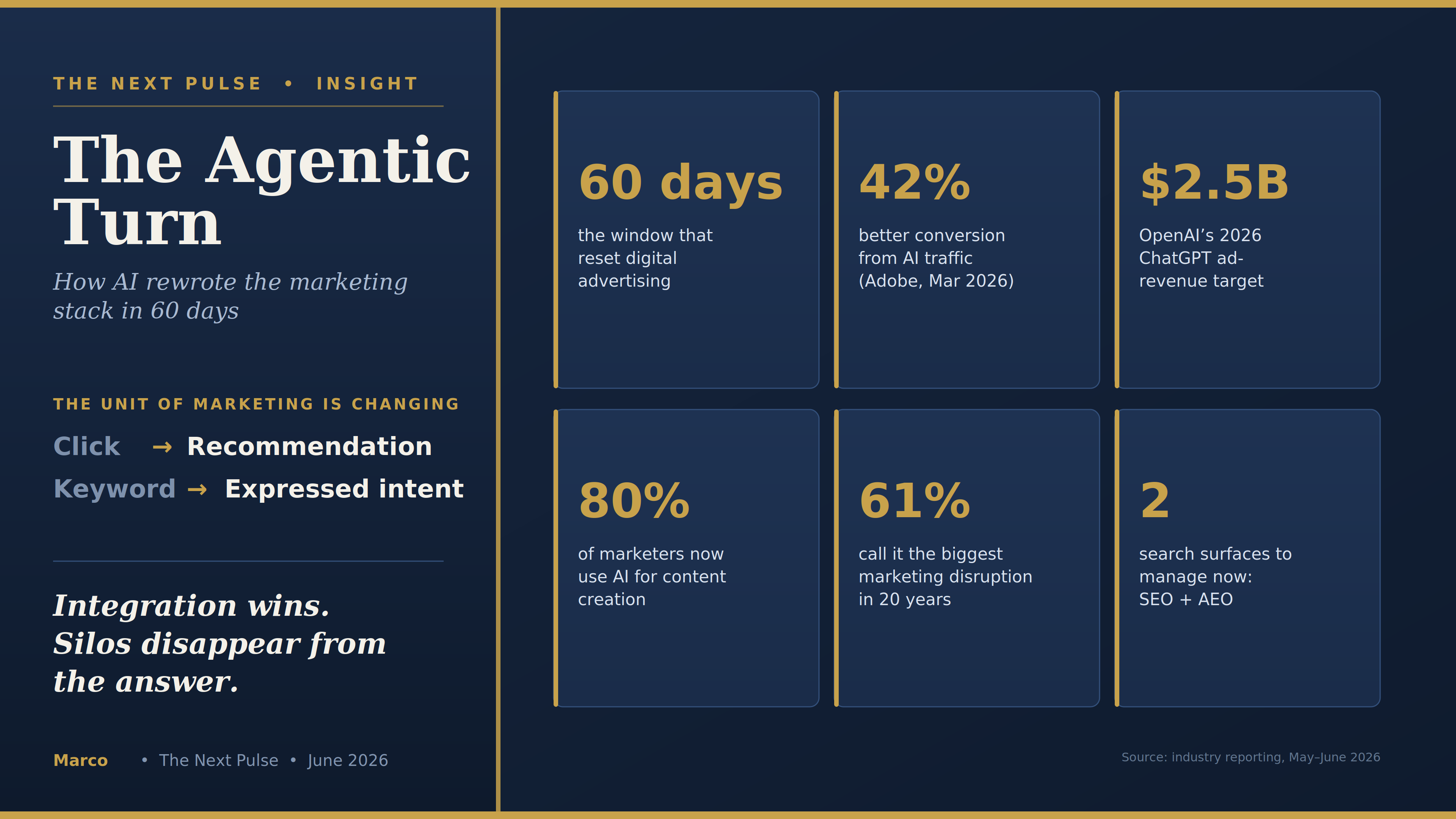
The Agentic Turn: How AI Rewrote the Marketing Stack in 60 Days
For two years, "AI in marketing" mostly meant faster copy and cheaper images. That era is over. In the sixty days between early May and mid-June 2026, the two dominant AI platforms didn't just add features — they rebuilt the foundation of how marketing works. The change can be summed up in one phrase: advertising moved inside the conversation.

May 2026
Digital Leadership Has Entered Its Judgment Era
Last week’s developments across AI, UX, CX, digital marketing, and e-commerce pointed to a deeper shift in how digital leadership creates value (check " The Next Pulse - May 25th "). As tools become smarter, interfaces cleaner, and the path from discovery to purchase more compressed, competitive advantage is moving away from manual channel execution and toward sharper judgment. The real differentiator is no longer access to technology, but the ability to decide what to automate, what to simplify, what to protect, and how to keep brand value intact as digital systems become more powerful.

April 2026
Why Your Data Is Not Ready for the Agentic Era
Platform data is typically "flat" — it reveals what happened but fails to capture the underlying business logic or intent. As AI agents take over media planning and customer decisioning, the CMOs who win will be the ones who engineered their data infrastructure years before everyone else caught on.

March 2026
Fifty AI Agents Walk Into a Marketing Team
When an AI agent can draft a launch narrative, pressure-test positioning, and spin ten campaign variants before lunch, the role of the CMO fundamentally changes. This is what running a modern marketing operation actually looks like — and what most luxury brands are still getting wrong.

February 2026
The Luxury Slowdown Is a Positioning Opportunity
Luxury executives expect 2026 to be a year where value outweighs volume, with brands prioritizing pricing power and brand desirability over growth at all costs. For CMOs, a tighter market is the best brief they will ever get — it forces clarity on what the brand actually stands for.

November 2025
AI Content at Scale Without Losing the Brand Voice
Brands that become adept at using GenAI, AI automation, and AI visibility to strengthen their narratives will avoid the sameness that results from overreliance on technology. Scaling from one post a day to two hundred is an engineering problem. Keeping every post sounding like your brand is a leadership challenge.

October 2025
The Phygital Flagship Is the New Media Channel
Physical retail experience is scaling up into temples of identity, merging architecture and spectacle to create cultural landmarks that no digital campaign can replicate. The store is no longer a distribution point — it's the most powerful content asset a luxury brand owns.