15 March 2026
Fifty AI Agents Walk Into a Marketing Team
When an AI agent can draft a launch narrative, pressure-test positioning, and spin ten campaign variants before lunch, the role of the CMO fundamentally changes. This is what running a modern marketing operation actually looks like — and what most luxury brands are still getting wrong.
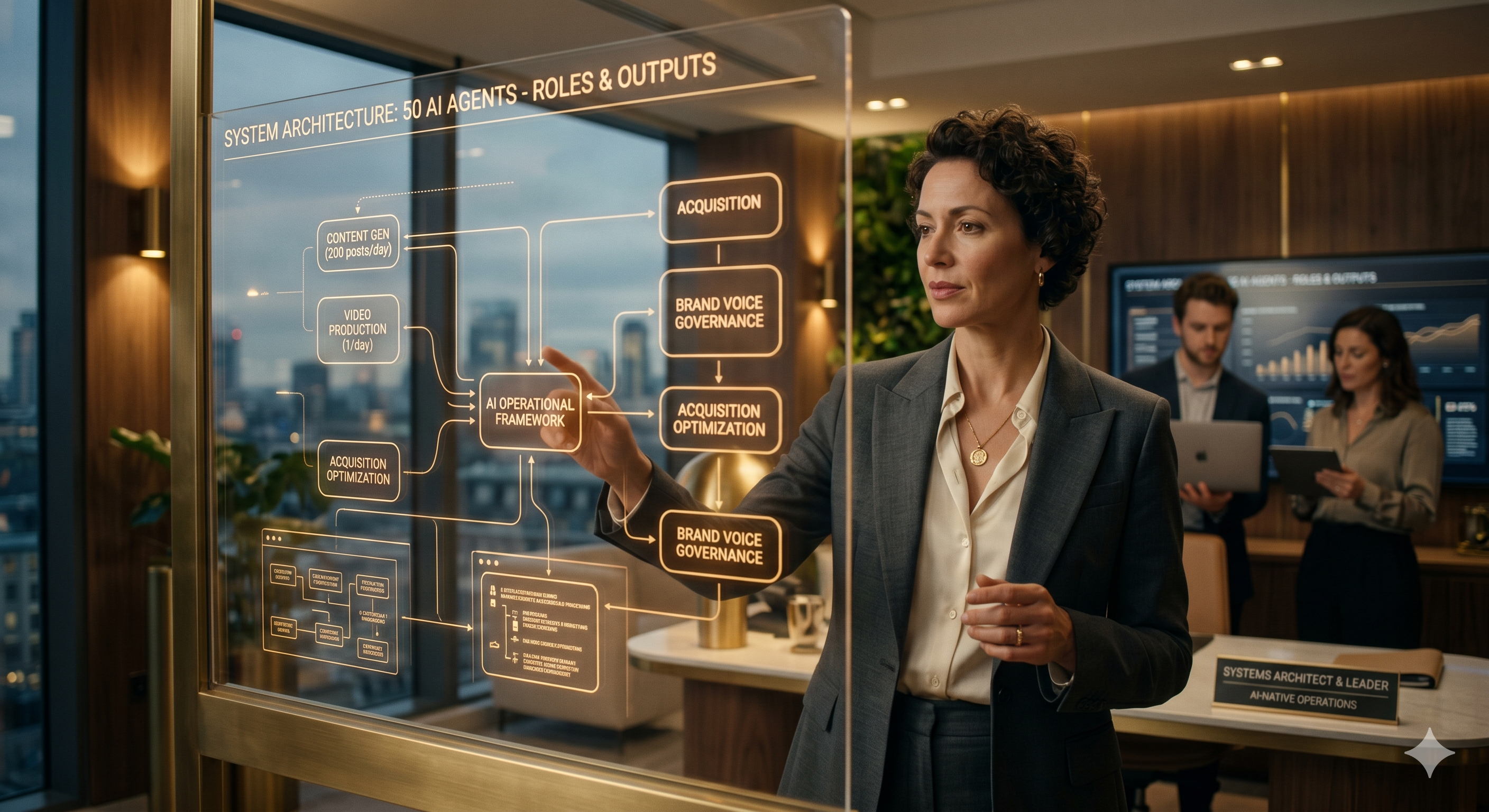
In my current company, we built something that most marketing organizations are only beginning to imagine. Fifty supervised AI agents, each with a defined role, operating inside a single marketing function. Content production scaled from one post per day to two hundred. Video went from one per month to one per day. And acquisition costs dropped significantly while the customer base grew at a record pace over the five-year period. These are not hypotheticals. This is what an AI-native marketing operation looks like when it is built with intention rather than retrofitted with tools.
The conversation in most boardrooms is still stuck on whether AI will replace marketers. That is the wrong question. The right question is what kind of marketing leader is required when AI handles the execution. The answer is someone who operates less like a creative director and more like an architect — designing systems, setting quality thresholds, governing brand voice, and making the strategic calls that no algorithm can make on its own.
Most luxury brands are still running AI as a series of disconnected pilots. A generative copy tool here, an image generator there. What they are missing is the operational transformation that comes from treating AI as a workforce multiplier — deploying agents that work in concert, each specialized, each supervised, each measurably accountable for output quality.
The industry is reaching a point where a team of two humans running sophisticated AI can deliver what previously required 20 people. The CMOs who recognize this are not cutting headcount. They are redeploying human talent toward the work that machines cannot do — cultural intuition, strategic judgment, and the kind of creative courage that defines a generation-defining campaign. That is the real opportunity. Most brands are so distracted by the tools that they can't see it.
Questions & answers
- How can luxury brands deploy agentic AI without diluting brand prestige?
- Luxury brands deploy agentic AI by focusing automation on back-end customization, clienteling preparation, and operational precision rather than mass generic communication. By using AI agents to equip human advisors with deep contextual client insights, brands elevate personal hospitality. This invisible integration maintains exclusivity while delivering highly tailored interactions.
- What role does agentic AI play in luxury clienteling and relationship building?
- Agentic AI enhances luxury clienteling by continuously analyzing high-value client preferences, purchase histories, and lifestyle milestones to predict individual desires. AI agents synthesize these signals into actionable recommendations for store associates and private client advisors. This synergy ensures every touchpoint feels bespoke, thoughtful, and deeply personal.
- How does AI personalization maintain scarcity and brand storytelling in luxury?
- AI personalization maintains luxury scarcity by curating private product recommendations and invitations tailored specifically to a client's status and preferences. Instead of broad promotional blasts, AI agents help tailor storytelling to highlight craftsmanship and heritage relevant to each buyer. This targeted approach reinforces brand allure and exclusivity.