15 June 2026
The Agentic Turn: How AI Rewrote the Marketing Stack in 60 Days
For two years, "AI in marketing" mostly meant faster copy and cheaper images. That era is over. In the sixty days between early May and mid-June 2026, the two dominant AI platforms didn't just add features — they rebuilt the foundation of how marketing works. The change can be summed up in one phrase: advertising moved inside the conversation.
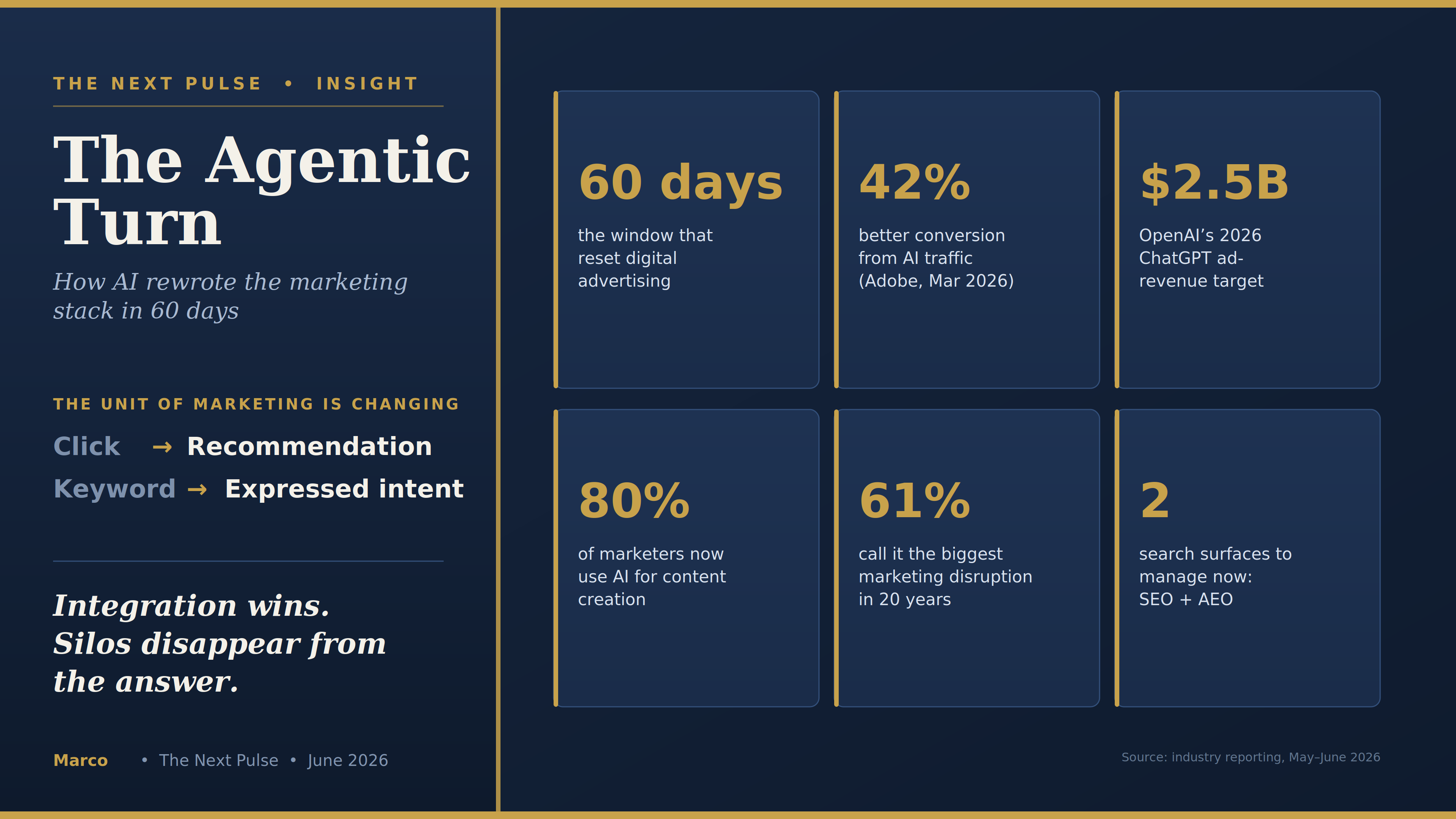
In the first half of May, OpenAI opened a self-serve advertising platform inside ChatGPT, matching placements to conversational intent rather than keywords or browsing history — and reportedly targeting around $2.5B in ad revenue this year. Days later, at Google Marketing Live, Google declared that Gemini is no longer a layer on top of its ad products; it's the operating system beneath all of them, complete with ad formats that live inside the AI answer and a "Business Agent" that answers a prospect's questions before they ever click through.
The implication is structural. The unit of marketing is shifting from the click to the recommendation, and from the keyword to expressed intent. Early data show AI-search traffic converting dramatically better than traditional traffic — by one measure, ~48% better. Higher intent, fewer clicks, harder measurement.
That shift forced a second one into the open. As Google's May core update finished rolling out in early June, marketers reported a split outcome: some recovered traditional rankings while losing placement in AI answers. The conclusion is now unavoidable — classic search and AI-answer search are two separate visibility surfaces. Answer Engine Optimization (AEO) is now a discipline distinct from SEO, and "getting found" requires two scorecards, not one.
Meanwhile, June brought the plumbing (open standards like the Ad Context Protocol, letting agents transact on a brand's behalf), a sobering reckoning (a CMO ROI crisis driven by fragmented martech that can't prove return to the CFO), and a cultural counter-current (a backlash against generic AI creative, with the industry heading into Cannes Lions leaning hard into human creative authority).
The takeaway across fintech, luxury, and consumer is the same: integration wins, silos lose. The brand that shows up well in an AI answer has consistent positioning across every surface, structured information a machine can parse, and a human creative core worth recommending. As generation becomes infinite and free, the premium moves to what can't be generated on demand — original data, genuine taste, and brand worlds with real cultural weight. That's where the next pulse of marketing will be felt.
Read the full white paper for the complete analysis, the SEO-vs-AEO breakdown, and a 90-day CMO playbook.
Downloads
Questions & answers
- What is the "Agentic Turn" in marketing technology?
- The Agentic Turn represents a shift from static, human-operated software tools to autonomous AI agents capable of executing multi-step marketing workflows independently. Rather than relying on manual campaign setup and rule-based triggers, agentic architectures orchestrate research, content creation, audience segmenting, and performance optimization in real time. This evolution transforms the marketing stack into a dynamic, self-optimizing engine.
- How do autonomous AI agents alter marketing workflows?
- Autonomous AI agents collapse traditional operational bottlenecks by executing tasks concurrently across data analysis, creative adaptation, and channel distribution. Marketing teams transition from manual execution to supervisory strategic leadership, defining parameters while agents handle real-time optimization. This shift accelerates speed-to-market and enables micro-personalization at scale.
- What infrastructure is required to support an agentic marketing stack?
- An agentic marketing stack requires unified enterprise data architecture, standardized API integrations, and robust Model Context Protocols (MCP). Clean, centralized data ensures agents access accurate real-time context without hallucinating or breaking brand compliance. Establishing clear guardrails allows autonomous agents to operate safely and effectively across customer touchpoints.