23 September 2026
The Roman Aqueduct of AI: Scaling Enterprise Infrastructure
Enterprises should scale artificial intelligence by treating data architecture like Roman aqueducts—engineering continuous, unglamorous pipelines that channel verified institutional knowledge directly into operational workflows. By turning repetitive human procedures into codified products and aligning infrastructure with long-term capital allocation, organizations transform isolated pilots into permanent, scalable balance-sheet value.

The Roman Aqueduct of AI: Turning Repeatable Processes into Enterprise Infrastructure
When historians look back at the Roman Empire, they often debunk a popular myth: Rome did not conquer and govern the Mediterranean world simply because its legionaries carried sharper swords. Tribal warlords and rival kingdoms often possessed fiercer fighters. Rome built a civilization spanning three continents because of an unglamorous, obsessive mastery of civil infrastructure.
While adversaries relied on individual battlefield heroics, Rome constructed standardized stone highways (the Via Appia) and gravity-fed aqueducts (like the Aqua Claudia). Over fifty miles of rugged terrain, Roman civil engineers maintained a relentless, gentle downward slope of just one foot for every two hundred feet of distance. That quiet engineering marvel delivered 200 million liters of fresh water into Rome every single day. The aqueducts did not care about the weather, individual fatigue, or shifting politics; they turned a chaotic natural resource into permanent, scalable municipal power.
In late 2026, corporate boardrooms are repeating the mistake of Rome’s adversaries.
Nearly 80% of enterprise leaders admit they are struggling to extract balance-sheet returns from generative AI. The reason is structural: executives are behaving like tribal chieftains purchasing shiny new weapons—renting commercial large language models, running fragmented departmental demos, and telling employees to "experiment."
Sustainable enterprise value does not come from handing workers a blank prompt box. It comes from the unglamorous Roman engineering of AI: building durable data aqueducts that channel institutional knowledge directly into operational workflows, turning ad-hoc human procedures into standardized software products.
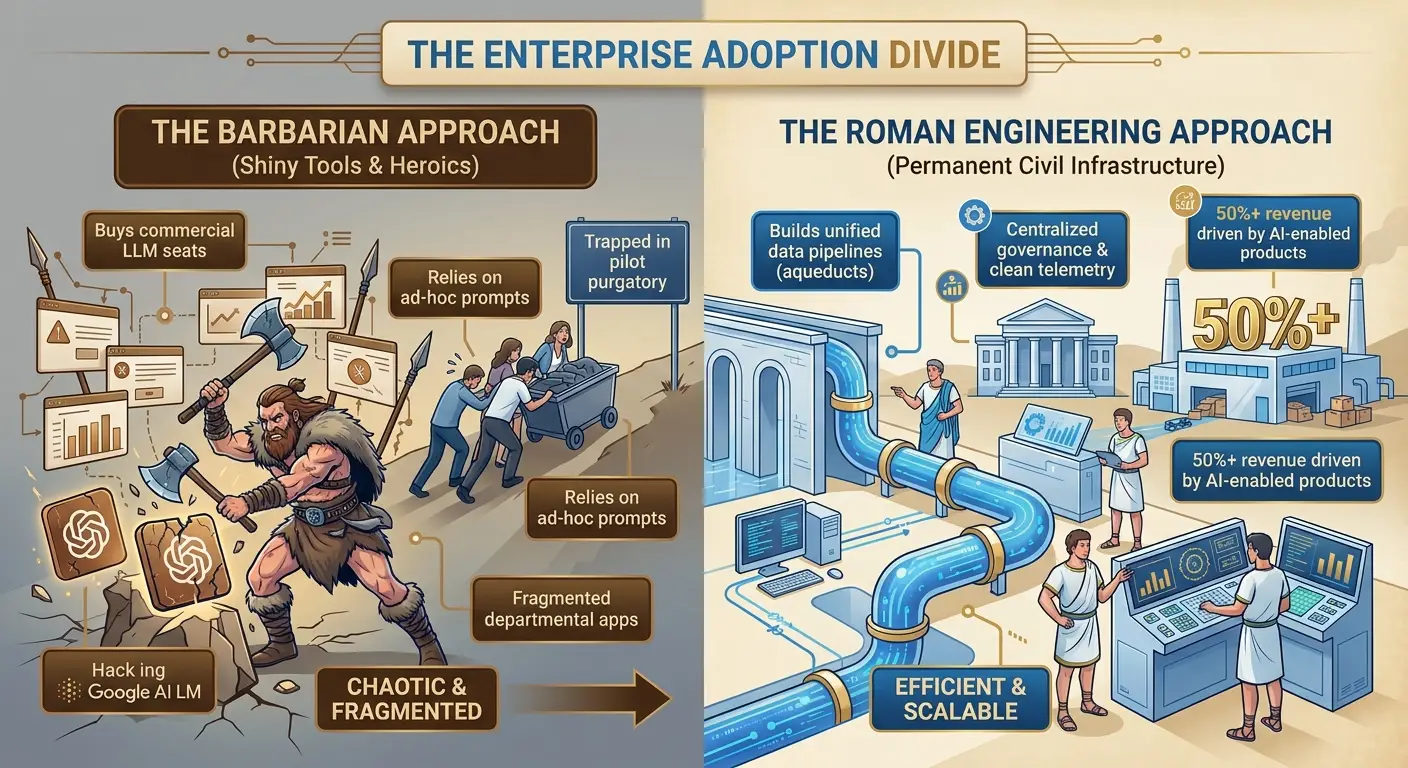
Challenge 1: The "Barbarian Chieftain" Fallacy (Buying Swords Instead of Building Aqueducts)
Across the Fortune 500, billions of dollars have been spent over the past thirty-six months licensing commercial foundation models. Yet when employees open these tools, productivity gains plateau after an initial burst of drafting emails and summarizing slide decks.
The breakdown occurs because models are detached from the company’s operational plumbing:
A generic language model knows nothing about your proprietary warranty clauses, historical credit risk tables, or mechanical repair logs.
When data is trapped in isolated departmental silos, models starve for accurate context, resulting in hallucinations that legal and security teams cannot tolerate.
Forcing knowledge workers to constantly copy-paste data between legacy CRM systems and external chat windows creates friction, user fatigue, and unmonitored Shadow AI.
The Solution: Stop buying swords and start building aqueducts. Competitive advantage in 2026 does not belong to the company with the largest rented model; it belongs to the enterprise that connects its operational data reservoirs directly to the frontlines.
As Caterpillar demonstrated with its Helios platform (aggregating telemetry from 1.6 million connected physical machines), the generative assistant inside the cab was built in just ten months because the data aqueduct had already been engineered.
Challenge 2: Turning Repeatable Processes into Scalable Products
In professional services, healthcare, and financial underwriting, organizations often treat expert knowledge as an artisanal, unscalable craft.
On Enterprise AI Innovators, Mark Sherwood, Chief Information Officer at Wolters Kluwer, revealed how a century-old publisher transformed into a digital software powerhouse where over half of its total corporate revenue is generated from AI-enabled products:
Rather than asking lawyers, tax accountants, and physicians to prompt external models, Wolters Kluwer identified recurring operational friction points: drafting Standard Operating Procedures (SOPs), identifying hidden risk in commercial contracts, and predicting IT outages.
They codified the domain expertise of their internal specialists into standardized rules, trained compact models on their proprietary legal and healthcare databases, and wrapped them into turnkey software products.
Each initiative began not with an exploratory "AI science project," but with a specific business metric: reducing contract review turnaround from five days to twenty minutes while guaranteeing 100% auditability.
The Business Takeaway: If an internal business process is repeated more than fifty times a week, do not leave it to ad-hoc human prompting. Codify the workflow into a structured, automated product that executes consistently across the entire organization.
Challenge 3: The Physical Compute Bedrock and Geopolitical Supply Chains
Business leaders often speak of artificial intelligence as if it were an ethereal cloud phenomenon. But beneath every algorithm lies the most concentrated, physically vulnerable supply chain in human history.
In his landmark economic and geopolitical study, Chip War: The Fight for the World's Most Critical Technology , Tufts University economic historian Chris Miller exposes the sobering physical reality facing enterprise digital strategists:
Enterprise AI relies on extreme ultraviolet (EUV) lithography tools manufactured by a single Dutch company (ASML), utilizing optics produced exclusively in Germany (Zeiss), fabricated on silicon wafers primarily in Taiwan (TSMC), and packaged using complex global chemical supply chains.
At the same time, regional power grids are reaching severe capacity constraints, with sovereign nations competing for energy allocations to power massive data centers.
The Strategic Consequence: Enterprise architectures that rely entirely on a single commercial cloud vendor expose themselves to acute geopolitical, regulatory, and pricing volatility.
Forward-thinking organizations follow the sovereign hybrid model: running compact Small Language Models (SLMs) on local server clusters or private virtual clouds for 80% of daily transactions, reserving expensive public foundation models strictly for complex, non-sensitive edge cases.
The Executive Playbook: The Four Civil Engineering Rules for AI
To transition your enterprise from ephemeral pilots to permanent operational infrastructure, execute these four leadership mandates:
Audit Your Data Gradients (The Aqueduct Rule): Ensure your data flows with zero manual friction from operational databases to decision frontlines. If your teams have to re-enter data manually, your aqueduct is broken.
Turn Repeatable SOPs into Products: Appoint dedicated "Business Translators" (following Davenport & Mittal's All-In on AI framework) to extract the tacit knowledge of senior workers and embed it into automated, auditable software tools.
Decouple from Monolithic Cloud Lock-in: Follow the insights of Chris Miller. Design a diversified compute strategy that blends on-premise open-weights models with private cloud endpoints to insulate your balance sheet against supply chain disruptions.
Enforce the 10/20/70 Capital Allocation: Maintain strict budget discipline. Allocate 10% to algorithmic tools and 20% to data pipelines. Commit the remaining 70% to organizational redesign, operational training, and change management.
Questions & answers
- Why do our enterprise AI pilots stall after showing early promise in employee testing?
- Pilots stall because organizations focus on the tool rather than the underlying data infrastructure. When employees test generative AI on simple tasks, the interface feels impressive. But when applied to complex operational workflows, the model lacks access to clean, unified corporate data, leading to hallucinations and manual workarounds. To scale past pilot purgatory, leaders must build continuous data pipelines (aqueducts) that feed verified enterprise records directly into the software interface.
- How can an organization transition from ad-hoc employee AI usage to scalable corporate products?
- Follow the "Process-to-Product" framework pioneered by Wolters Kluwer. Audit your business units to identify repetitive, high-frequency expert tasks (such as reviewing commercial contracts, drafting standard operating procedures, or analyzing regulatory compliance). Codify the rules of that procedure into a standardized, auditable software workflow powered by domain-specific models, transforming artisanal human effort into an automated internal product.
- How should CIOs and CFOs mitigate the rising cost and supply chain risks of foundation models?
- Grounded in the structural supply-chain insights of Chris Miller’s Chip War, leaders must avoid single-vendor cloud lock-in by implementing a hybrid compute model. Run compact, fine-tuned open-weights Small Language Models (SLMs) on private corporate infrastructure for the 80% of routine internal transactions that require strict privacy and sub-second latency. Reserve high-cost public commercial models strictly for specialized edge cases, insulating your balance sheet against cloud token inflation and semiconductor supply disruptions.