30 September 2026
Re-Founding Incumbents: Scaling Enterprise AI Adoption
Enterprises achieve transformative balance-sheet returns from AI by reorganizing their underlying organizational physics rather than layering commercial software over legacy workflows. By codifying operational data into machine-readable ontologies, automating centralized high-density bottlenecks like credit underwriting, and directing AI toward administrative process while human staff drive customer relationships, leaders turn stagnant pilots into scalable, high-margin engines.

Re-Founding the Incumbent: Why Reorganizing Organizational Physics Beats Buying SaaS
Every senior corporate executive running an established enterprise faces the same frustrating paradox in late 2026. Over the past thirty-six months, your organization has authorized millions of dollars in software subscriptions, commercial model seat licenses, and external technology consulting retainers. Yet when you walk the corridors or review quarterly operating margins, almost nothing fundamental has changed. Workflows remain sluggish, back-office headcounts continue to creep upward, and your most experienced domain specialists spend hours wrestling with fragmented spreadsheets, disconnected CRMs, and manual compliance handoffs.
The corporate diagnosis is almost always flawed: leadership assumes the models aren't smart enough, the software vendors need more time, or employees are simply resistant to change.
The real breakdown is structural. Most organizations are treating artificial intelligence like a shiny attachment bolted onto a legacy human assembly line. Handing individual knowledge workers a conversational chatbot to speed up typing by 12% does not transform an enterprise. Sustainable balance-sheet value only emerges when leadership dares to re-found the incumbent: breaking down the company's underlying organizational physics, codifying institutional knowledge into unified data ontologies, and deploying "AI for process" while reserving human talent for relationship-driven trust.
Challenge 1: The Incrementalism Trap (Selling to the Legacy Assembly Line)
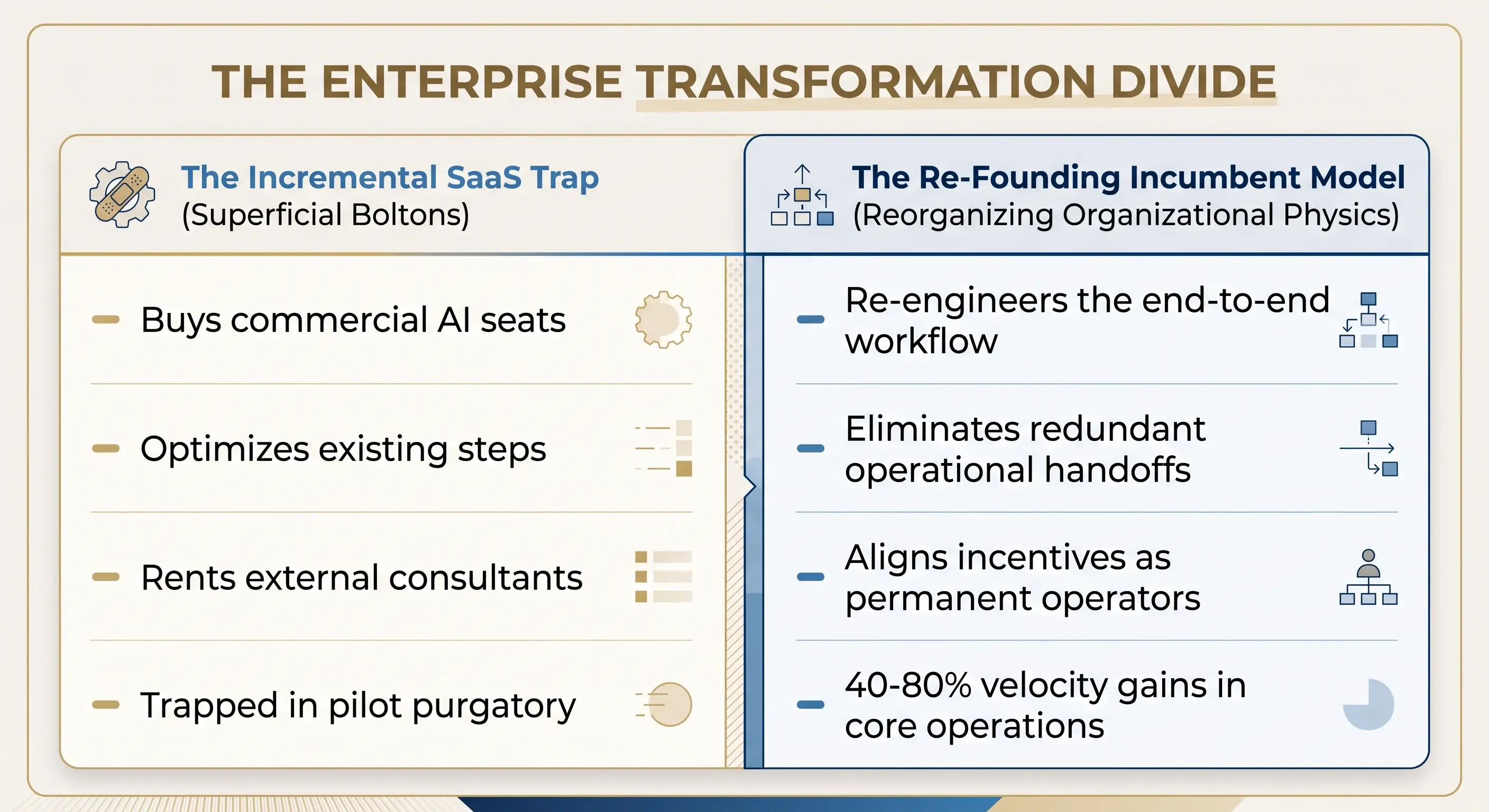
When enterprise leaders seek external support to modernize, they confront three traditional paths, all of which suffer from severe structural misalignments:
The Internal DIY Deadlock: An established enterprise struggles to recruit world-class AI engineers because of its internal cultural genetics. In a private equity fund, the "celebrated persona" is the investor. In an investment bank, it is the dealmaker. In an industrial firm, it is the plant manager or commercial sales lead. When the celebrated persona is not the software engineer, the organization cannot attract or retain elite technological builders.
The External Services Dilemma: Partnering with traditional IT consulting firms creates a classic incentive conflict. Services firms optimize for expanding their share of your wallet and maximizing billable hours. Because their revenue model is tied to human headcount, their business model incentivizes incremental advisory engagements rather than structural automation that permanently eliminates billable tasks.
The Commercial SaaS Bottleneck: Software-as-a-Service vendors face their own architectural constraints. To build a venture-scale business, a SaaS company must target homogeneous, widely shared business processes. Consequently, vendors build software that sells to your existing human assembly line as it operates today. They automate minor sub-tasks (like drafting an email or summarizing meeting notes) while leaving the inefficient, multi-departmental workflow completely intact.
The Strategic Antidote: Break the cycle by taking an owner-operator mindset. On No Priors AI, Machine Learning, Tech, & Startups
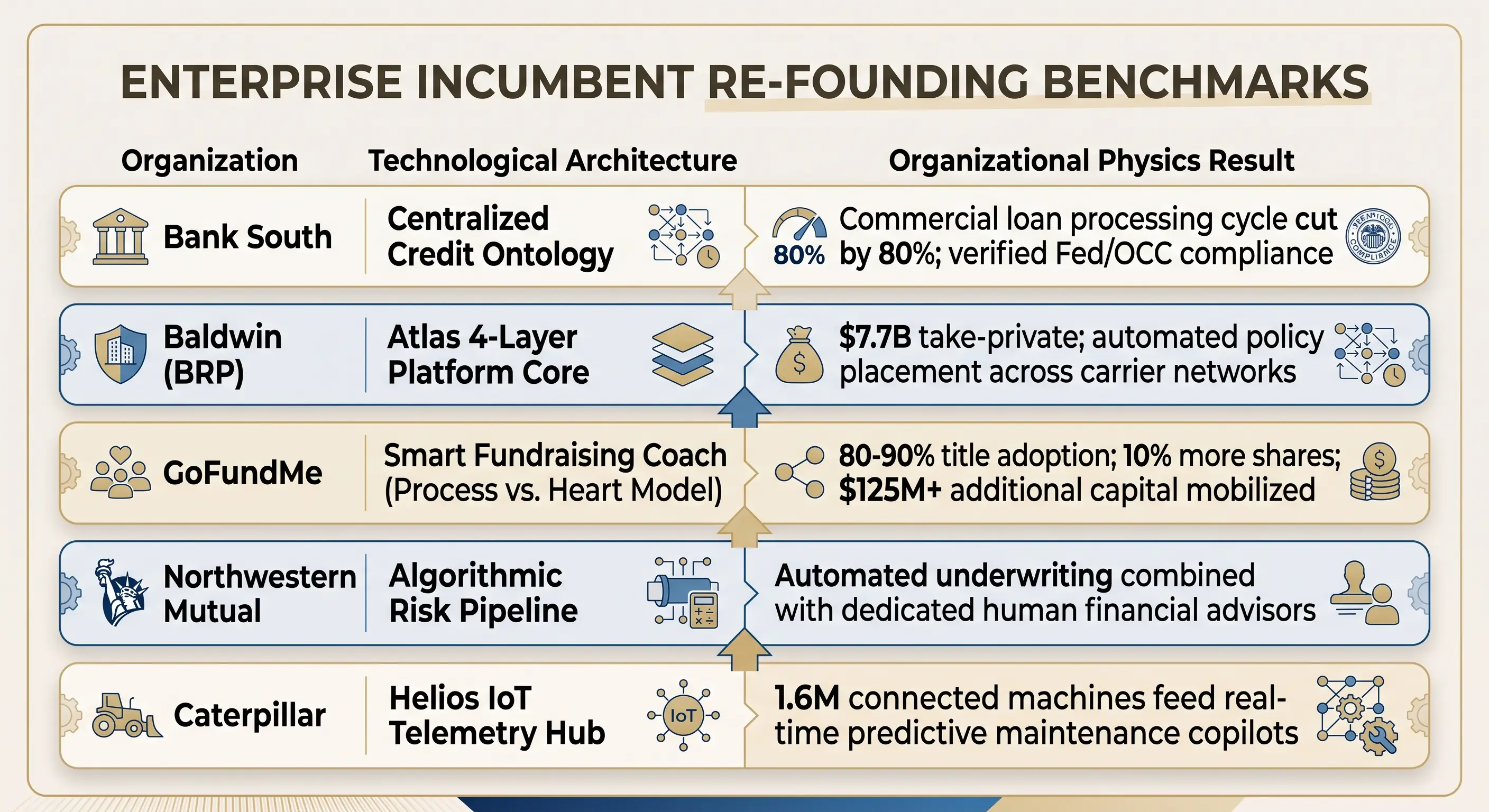
[05:27], Michael Lee, CEO of Sequence Holdings (which recently completed the historic $7.7 billion take-private transaction of insurance broker Baldwin alongside the Dell family office), articulated the core problem:
"What we typically see from software companies producing AI agents today is this giant push to give small machines to every human in the human assembly line and to speed up work. There's nothing wrong with that... but when you have machines that can work 24/7, that can scale with electricity, that can accomplish what no individual human can do, the right answer is to think about how do you start to reorganize what an organization should be."
Challenge 2: Mastering Organizational Physics (The Bank South Blueprint)
Not every corporate process is a candidate for high-return AI transformation. Organizations that attempt to automate twenty disparate departmental experiments simultaneously invariably squander capital.
Success requires analyzing organizational physics: the structural relationship between operational density, centralization, and economic leverage.
The High-Density Advantage: In operationally dense environments—such as commercial banking underwriting, insurance brokerage placement, or corporate risk assessment—critical business logic flows through a centralized technical core, even if customer distribution is geographically dispersed.
The Real-World Banking Case: In Georgia, Bank South (a commercial financial institution generating over $100 million in revenue) partnered with Sequence Holdings to re-found its operational architecture. Traditionally, community banks struggle to compete with Wall Street giants due to heavy compliance overhead and slow loan turnaround times.
Regulatory Compliance as a Feature: As Michael Lee noted on No Priors AI, Machine Learning, Tech, & Startups
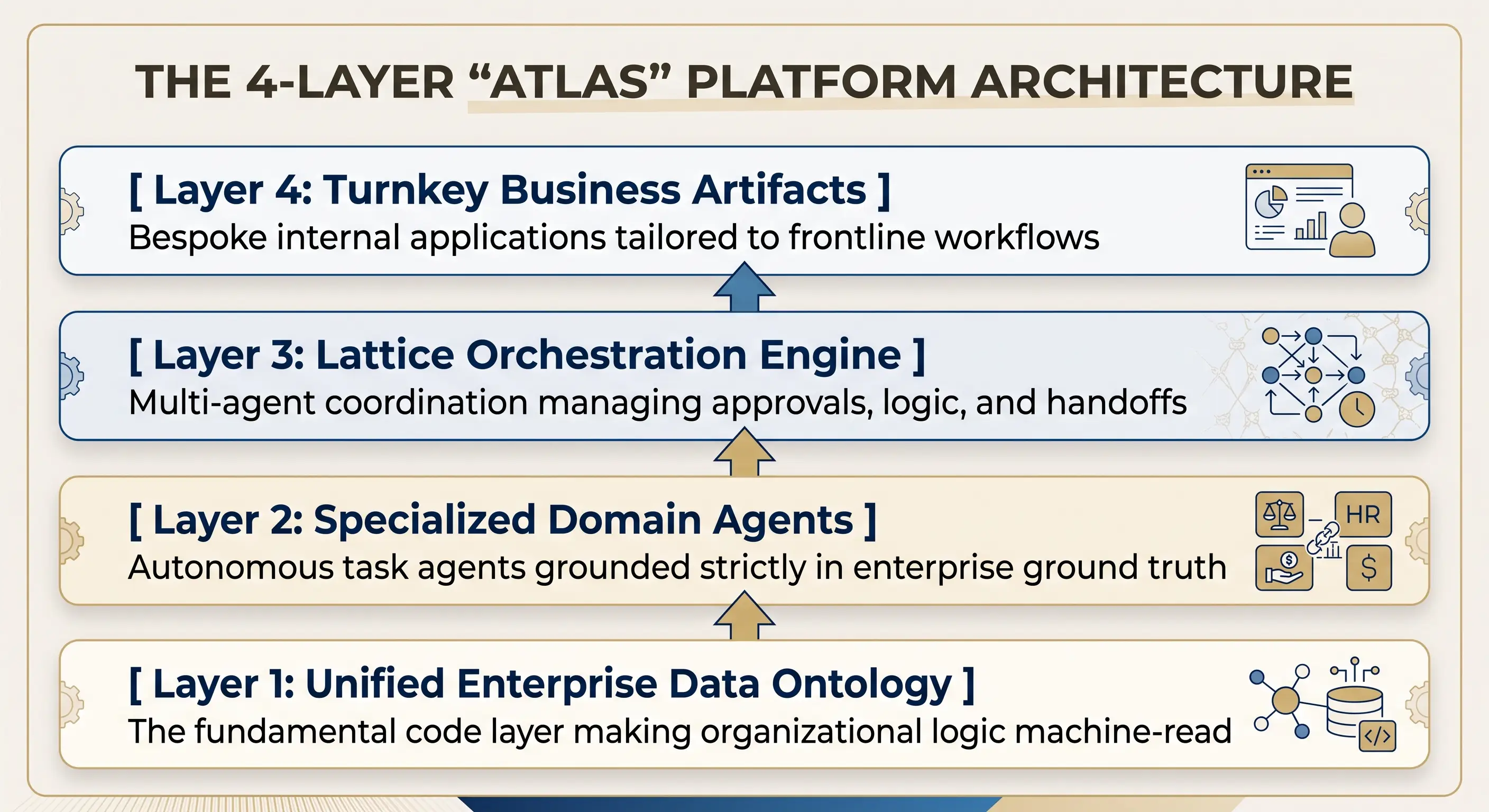
[16:22], Bank South's highly regulated environment was a strategic advantage rather than an impediment. Because banking operations are strictly audited, data hygiene is exceptional and underwriting rules are explicitly codified.Centralized Amortization: While Bank South maintains dozens of physical branch locations, commercial loan underwriting happens centrally. By building a unified Data Ontology (codifying customer entities, loan covenants, and regulatory compliance directly into code), Bank South deployed specialized AI agents that pre-underwrite complex credit applications in minutes rather than weeks. Because the operational core is centralized, every automation engineered at headquarters is instantly amortized across all retail branches.
Challenge 3: "AI for Process, People for Heart" (The GoFundMe Principle)
When companies attempt to automate high-stakes workflows, they often trigger fierce workforce resistance or alienate customers by introducing sterile, robotic interactions.
The breakthrough operating principle comes from Me, Myself, and AI, the executive podcast produced by the MIT Sloan Management Review and the Boston Consulting Group (BCG). In a deep-dive interview, Tim Cadogan, CEO of GoFundMe (which has facilitated over $40 billion in community funding), shared how his organization scaled operations across more than 10,000 new campaigns per day:
The Cognitive Overload of First-Timers: When an individual faces an unexpected crisis, they experience acute cognitive paralysis. Deciding how to write a compelling title, which photos to select, and how to set a realistic fundraising target creates intense friction. Previously, GoFundMe relied on a dedicated support team, but manual staffing could never keep pace with 10,000 daily cases.
Removing the Blank Page: GoFundMe engineered an AI-powered "Smart Fundraising Coach." Drawing on the empirical patterns of tens of millions of historical fundraisers, the coach analyzes user inputs and suggests high-performing campaign titles, incremental funding milestones, and tailored one-on-one outreach text. Over 80% to 90% of organizers adopt the AI-generated titles, cutting creation drop-off rates and driving an estimated $125 million in additional community support this year alone.
Protecting the Human Connection: Cadogan emphasized that AI should strictly handle process, not emotional connection:
"At the heart of GoFundMe is human connection... It is about love and care and feeling, and that comes from knowing someone's reality. That's why the AI helps with the process, but the people bring the heart."
Rather than attempting to fake human empathy with generative chatbots, GoFundMe uses AI to remove administrative cognitive load, allowing organizers to focus on genuine, personal one-on-one conversations with their supporters.
The Executive Playbook: The Four Rules of Incumbent Reinvention
To move beyond superficial software add-ons and re-found your enterprise for the AI era, execute these four executive mandates:
Map Your Organizational Physics Before Buying Software: Identify the centralized, high-density decision nodes in your business (such as credit underwriting, insurance pricing, or proposal drafting). Focus your primary engineering investments on automating these centralized bottlenecks where improvements immediately amortize across the entire organization.
Build the Proprietary Data Ontology First: Artificial intelligence cannot automate what it cannot comprehend. Follow Sequence Holdings' Atlas framework: codify your company’s institutional rules, customer relationships, and operational data into machine-readable software objects before launching agentic workflows.
Enforce the "AI for Process, Humans for Heart" Boundary: As proven by GoFundMe, deploy AI to eliminate the administrative cognitive load of the blank page (drafting proposals, calculating ratios, structuring summaries). Reserve your human workforce for what machines cannot replicate: high-empathy client negotiations, ethical oversight, and personal relationship management.
Solve the Human Engineering Problem First: As documented in Hassan Osman’s AI Change Management Made Simple, technological transformations fail when employees view AI as an existential threat. Frame agentic systems as cognitive armor that strips away soul-crushing administrative drudgery, freeing frontline teams to win more business and serve clients with greater dedication.
Questions & answers
- Why do our commercial SaaS AI subscriptions fail to generate noticeable bottom-line ROI?
- Commercial SaaS products are engineered to solve broad, homogeneous tasks so they can be sold across thousands of companies. Consequently, they optimize the existing human assembly line—automating isolated tasks like summarizing notes or drafting emails—without altering your underlying workflow. Real balance-sheet returns only materialize when an enterprise reorganizes its operational architecture, eliminating redundant handoffs and embedding proprietary business rules directly into automated products.
- How did Bank South successfully deploy AI in a highly regulated commercial banking environment?
- Bank South leveraged its regulated environment as a strategic advantage. Because banking operations require strict compliance, their operational rules and audit trails were already clearly defined. By codifying these credit criteria into a machine-readable data ontology, Bank South automated the underwriting core at headquarters. Because loan underwriting is centralized, the software investment amortizes across all commercial branch offices, cutting loan turnaround times by 80% without customer data ever leaving their private network.
- What does "AI for process, people for heart" mean for enterprise workforce strategy?
- As demonstrated by GoFundMe CEO Tim Cadogan on MIT SMR's Me, Myself, and AI, the model dictates that AI should handle operational cognitive drag—such as drafting standardized text, structuring proposals, and evaluating quantitative milestones—based on historical pattern recognition. Human professionals are freed from administrative drudgery to focus exclusively on what software cannot do: empathetic communication, relationship building, and complex ethical judgment.