10 August 2026
The Next Pulse August 10th
Navigating Agentic AI, Cognitive UX, and Autonomous Commerce.
This week's briefing highlights the operational shift toward autonomous, agentic workflows; hyper-personalized customer-experience architectures; AI-mediated e-commerce discovery; evolving ad formats across conversational interfaces; and neuroscience-backed System 1 persuasion models. Senior executives must align technical infrastructure with cognitive decision frameworks to secure sustained competitive advantage in rapidly adapting markets.
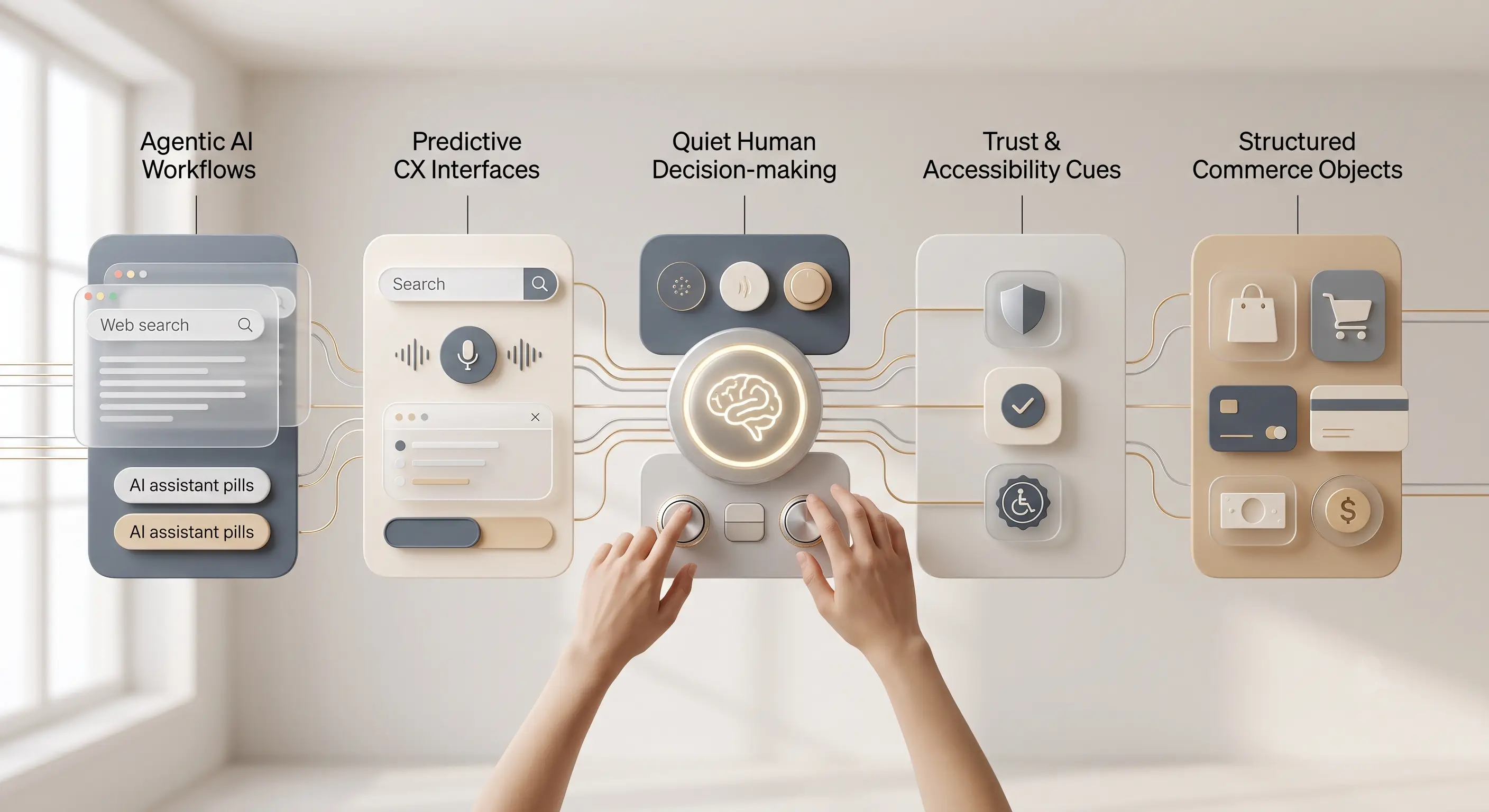
AI, Gen AI, and Agentic AI
Enterprise deployment is accelerating as organizations shift from static generative models to autonomous agentic architectures. Recent intelligence from Futurum Research highlights that over 56% of enterprise AI investments now prioritize agentic CX and automated operational workflows, while open-weight developments reported by AI Business demonstrate expanding accessibility for customized multi-agent orchestration across complex business environments.
UI/UX/CX
Customer experience design is transitioning from traditional static interface components to predictive, hyper-personalized interaction flows. According to industry analysis from CX Network, prioritizing automated friction reduction and real-time contextual feedback loops allows brands to capture consumer intent instantly, while CustomerThink emphasizes how predictive AI interfaces streamline multi-turn user touchpoints seamlessly.
Commerce
Digital commerce discovery is rapidly migrating from traditional brand web properties toward AI-driven conversational intermediaries. Strategic market analysis by Deloitte Insights reveals that retail decision-making and checkout are increasingly executed via automated agents, while market research from Cross Border Association confirms that multi-brand marketplaces and agentic retail channels are growing twice as fast as legacy storefronts.
Digital Marketing and Advertising
Ad distribution networks are recalibrating as conversational search and ad-supported streaming platforms reshape consumer reach. Latest tracking by Two Octobers documents the integration of ad units directly into conversational LLM channels, while Ignite Visibility details critical updates across major search engines, forcing media buyers to focus on high-intent contextual placement and first-party data activation.
Neuromarketing
Neurological research continues to validate the primacy of System 1 processing in driving consumer purchasing decisions. Academic insights published by JMSR Journal demonstrate how immediate primal brain stimuli dictate brand engagement online, while Harvard DCE highlights how biometric and behavioral data are supplementing traditional market research to optimize choice architecture and reduce cognitive friction.
Strategic Takeaways
Transition to Agentic Execution: Shift AI priorities from simple content creation to autonomous, multi-step agentic workflows that handle end-to-end business logic.
Prepare for Intermediary Commerce: Optimize brand data, pricing feeds, and product schemas for AI buyer agents rather than solely optimizing human website visits.
Anchor Experience in System 1 Mechanics: Design digital touchpoints using strong visual contrast, immediate value triggers, and minimal cognitive strain to capture intuitive decisions.
Questions & answers
- How does Agentic AI differ operationally from standard Generative AI in enterprise workflows?
- Standard Generative AI focuses primarily on producing text or media based on explicit prompts. Agentic AI acts autonomously to execute multi-step goals, interface with external software APIs, reason through conditional rules, and complete tasks with minimal human intervention.
- What is the primary impact of AI intermediaries on digital e-commerce strategy?
- AI intermediaries shift product discovery and evaluation away from traditional search engines and site navigation. Brands must optimize product data for AI readability and structured schema, ensuring algorithms can parse features, pricing, and availability accurately.
- How can neuromarketing principles reduce conversion friction on digital interfaces?
- By targeting System 1 processing through visual contrast, tangible proof points, and clear default choices, brands align interfaces with intuitive decision-making, significantly lowering cognitive friction and accelerating user action.