7 October 2026
Machine-Native AI: Beyond Conversational Chatbots
Enterprise AI pilots fail when organizations use conversational language models to drive deterministic business processes. Language models are optimized to produce text strings for human reading, not discrete programmatic actions. By adopting machine-native decision models, treating AI as operational enablement rather than an end product, and embedding bounded models into existing enterprise software, leaders achieve scalable, auditable automation.

Beyond the Chatbot: Why Machine-Native Decisions Beat Conversational Strings
Ask any corporate CIO about their primary frustration in October 2026, and you will hear a version of the same paradox: Why is artificial intelligence capable of solving Millennium Prize mathematics problems, writing sophisticated code, and passing medical licensing exams—yet utterly incapable of reconciling a corporate invoice, updating a customer credit card, or processing a routine insurance claim?
Across global enterprises, millions of dollars have been spent deploying conversational assistants. Yet recent benchmark data published by Stanford University's HAI and Deloitte reveals that while 88% of enterprises now experiment with generative AI, only 25% have successfully transitioned more than 40% of their pilots into live production environments.
The fundamental cause is not a lack of computing power or model intelligence. It is an architectural mismatch.
For the past four years, the enterprise software industry has attempted to shoehorn string-optimized language models—designed to predict continuous sequences of words for human reading—into deterministic business processes that require discrete, structured, and auditable decisions. To unlock true enterprise automation, leadership must move beyond the conversational chatbot and embrace machine-native intelligence: scoping AI to make structured decisions that underlying software systems can act on with 100% reliability.
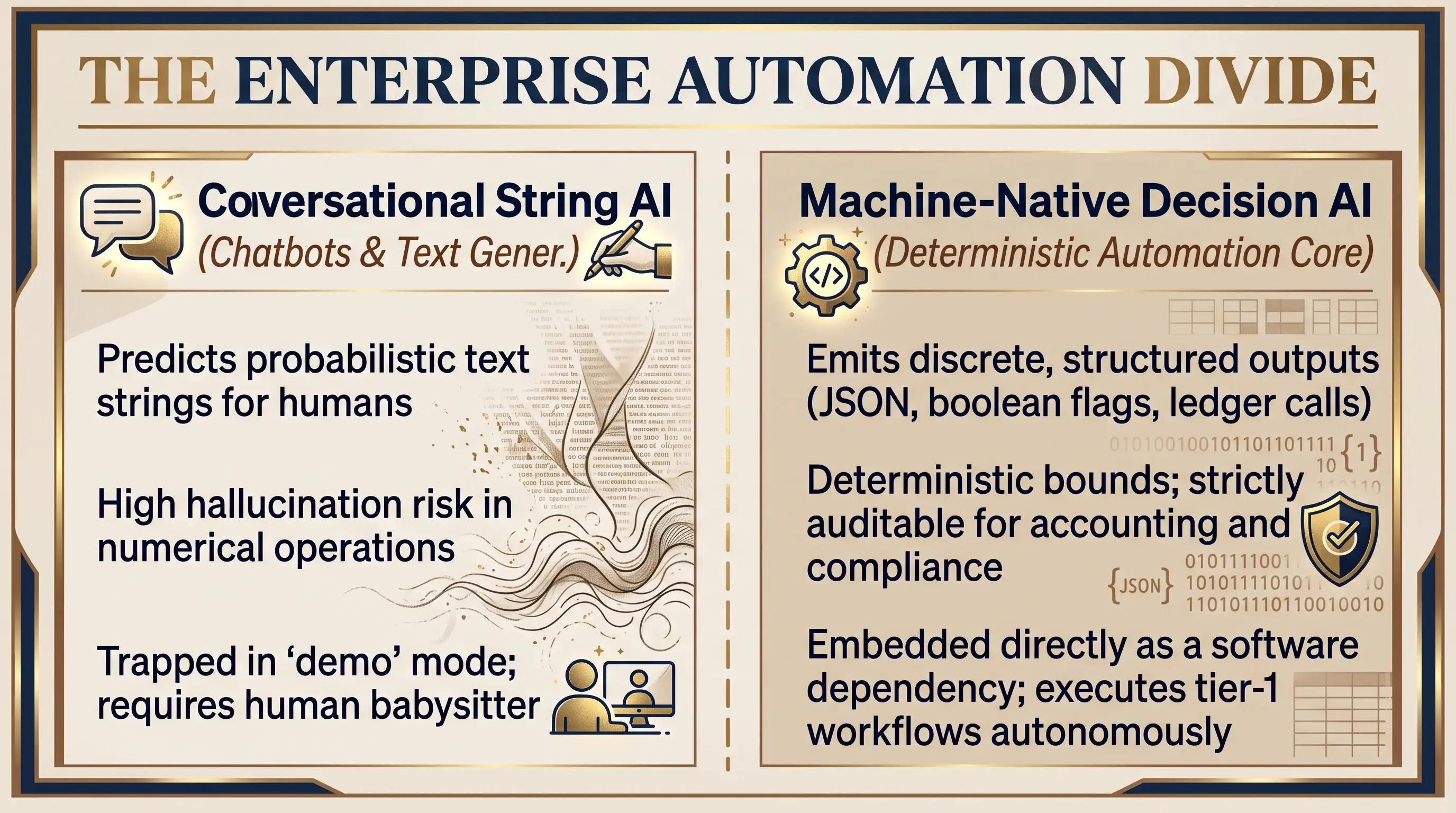
Challenge 1: The String Trap and Asymmetric Accuracy
The foundational reason enterprise automation has stalled is that language models are trained on the wrong objective function for business workflows.
On The TWIML AI Podcast [00:04:30], Diego Almeida, Co-Founder and CEO of Typesafe (and a former OpenAI engineer who worked on InstructGPT and the foundational Reinforcement Learning from Human Feedback [RLHF] systems), explained the root cause:
"You get what you optimize for. All the string LLMs have been optimized for strings, and strings are meant to be consumed by humans or other LLMs. But if you want something like accounting, that's meant to be consumed by a computer. You have specific fields, forms, and discrete decisions. It's very different to optimize for strings versus discrete decisions."
In consumer chat, a model that generates a slightly wordy or polite answer is praised. But in enterprise operations, accuracy is asymmetric:
If a customer support model summarizes a corporate policy politely, it gets a high score from a human evaluator.
But if that same model authorizes a $5,000 refund to an unauthorized account, it has committed an operational failure. From a pure mathematical accuracy standpoint, authorizing the wrong transaction is identical to typing gibberish—yet probabilistic language models have no internal understanding of corporate risk liability.
When enterprise developers attempt to connect conversational LLMs directly to core databases, the software architecture breaks down. Because large language models cannot provide strict abstraction boundaries, they fail unpredictably when faced with out-of-distribution corporate data.
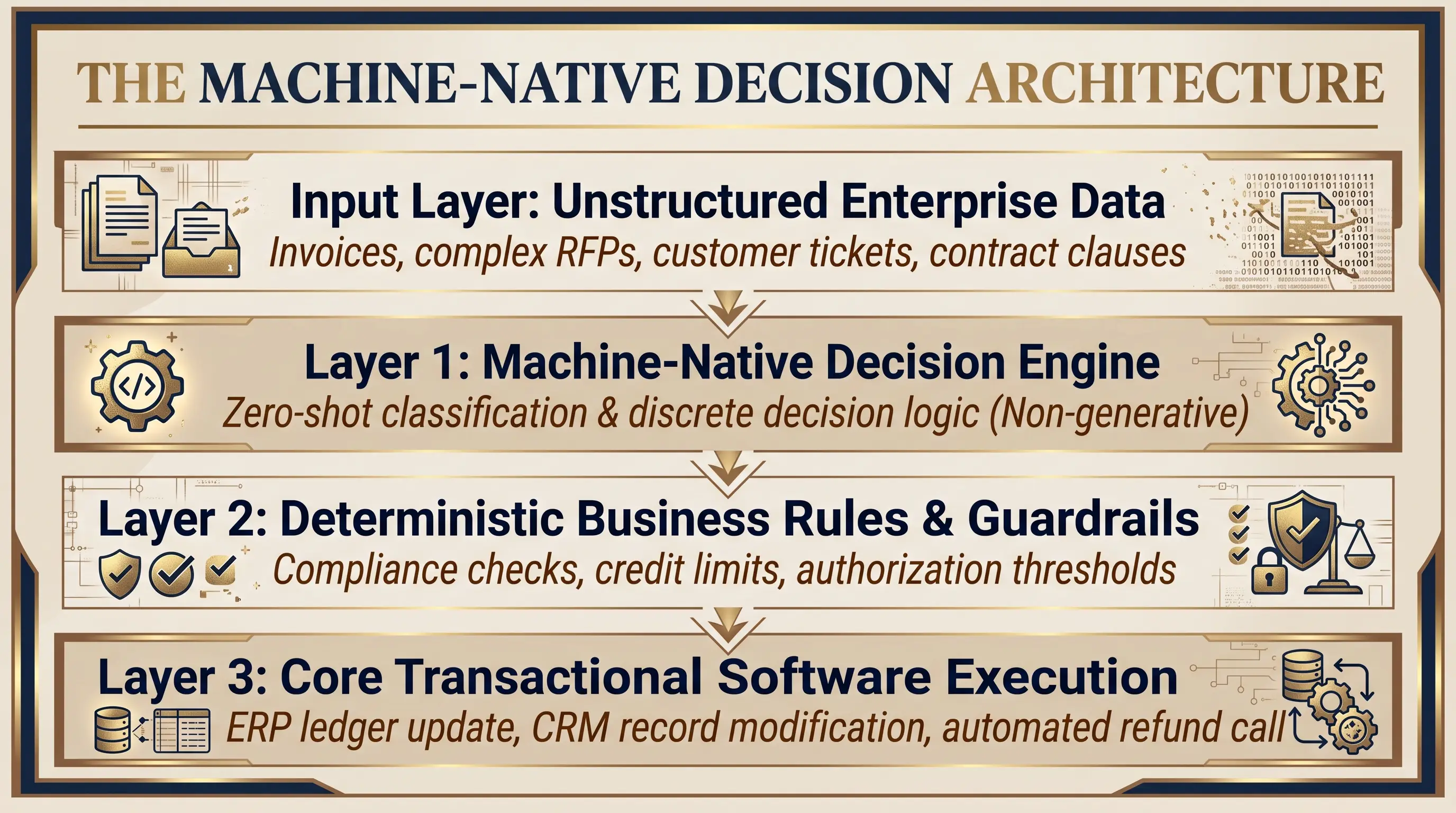
Challenge 2: Treating AI as Enablement, Not an Outcome
A second critical error corporate leaders make is treating artificial intelligence as a standalone deliverable rather than an operational enabler. When leadership commands departments to "ship an AI tool," teams inevitably build superficial conversational dashboards that sit isolated from actual work.
On Enterprise AI Innovators, Alexandra Guenther, Senior Vice President and Chief Information Officer at Leidos (a Fortune 500 defense, aviation, and national security enterprise with 50,000 global personnel), detailed how her organization bypassed the pilot trap:
The "Service Desk of the Future": Rather than giving internal IT staff a generic chatbot to help them type tickets faster, Leidos completely reimagined tier-1 corporate support. Guenther’s team mapped the top high-friction friction points across their 50,000 employees—such as password resets, software access provisioning, and hardware diagnostics.
Chained Specialized Automations: Instead of relying on a single, monolithic model, Leidos integrated more than a dozen micro-automations behind a unified interface. When an employee encounters a technical barrier, the system evaluates the problem, verifies the user's security clearance, and executes the resolution autonomously.
The Enablement Philosophy: As Guenther emphasized, AI is an enablement layer, not the end state. The goal was never to showcase a conversational model; the goal was to drive tier-1 support into complete, secure self-service, allowing human engineers to focus on complex mission-critical systems.
Challenge 3: Moving from "One Model Rules All" to Engineered Systems
Many enterprises stall because they buy into the vendor narrative that a single, massive foundation model will soon run their entire business. In practice, relying on a single generalist model creates fragile, un-debuggable systems.
As Diego Almeida observed on The TWIML AI Podcast , modern engineering success resembles autonomous driving platforms like Waymo rather than unconstrained prototypes:
Autonomous vehicles do not rely on a single end-to-end model to make driving decisions. They use decomposed, classically engineered software subsystems where each machine learning component is strictly scoped to what it does reliably—perception, trajectory prediction, sensor fusion—governed by hardcoded physics and safety interlocks.
In enterprise software, the path to production requires the same discipline: scope the machine learning model to bounded cognitive tasks (classification, entity extraction, ranking), and embed that model inside proven, deterministic software pipelines that handle transaction validation, database commits, and audit logging.
The Executive Playbook: Moving to Machine-Native Automation
To transition your enterprise from superficial chatbot pilots to robust operational automation, execute these four leadership principles:
Stop Buying Strings When You Need Decisions: Audit your current AI portfolio. If a team is using a conversational language model to generate unstructured text that an employee must copy-paste into an ERP or CRM, halt the project. Replace it with a machine-native decision model that returns structured parameters (JSON, status flags) directly into software workflows.
Treat AI as an Enablement Layer, Not an Outcome: Emulate Leidos’ governance framework. Never evaluate an AI project by how impressive its conversational demo looks. Measure it strictly by operational metrics: reduction in tier-1 ticket resolution time, elimination of manual data entry hours, and customer cycle time compression.
Decompose Monolithic Tasks into Micro-Automations: Do not attempt to build an "autonomous employee." Break complex business processes into discrete, verifiable steps. Use machine learning only for the specific steps requiring cognitive classification or extraction, and use deterministic code for transaction execution.
Bridge the Operational Translation Gap: As Thomas Davenport and Nitin Mittal emphasize in All-In on AI, deploy dedicated "business translators." Software engineers must not build models in isolation from operational reality; translators ensure algorithms reflect real-world business tolerances and compliance guardrails.
Questions & answers
- Why do our conversational AI chatbots fail when tasked with executing business transactions?
- Conversational models are trained to predict the next word in a sentence for human consumption. They excel at synthesizing open-ended text and answering general questions, but lack the deterministic constraints needed for business transactions. Executing a transaction—such as changing a billing address, approving a credit limit, or booking an invoice—requires exact, discrete decisions with zero room for probabilistic variation. For transactional execution, enterprises must deploy machine-native decision models integrated into deterministic software pipelines.
- What does "treating AI as enablement, not an outcome" mean for capital allocation?
- As demonstrated by Leidos CIO Alexandra Guenther, it means you do not budget for "AI projects" in isolation. Instead, you identify existing corporate bottlenecks—such as tier-1 IT support, contract reviews, or billing reconciliations—and fund business process redesigns where AI acts as the underlying acceleration engine. Success is measured by operational velocity and cost-per-transaction, not by model complexity or chatbot engagement metrics.
- How do we prevent our autonomous agents from making catastrophic operational errors?
- Avoid using monolithic, end-to-end models to govern entire business workflows. Instead, emulate the engineering principles of autonomous aerospace systems: decompose workflows into modular components. Use machine learning models strictly for cognitive tasks like classification or entity extraction, and surround them with hardcoded, deterministic business logic that enforces credit limits, regulatory compliance checks, and human sign-offs before any irreversible action is committed to an enterprise database.