1 September 2026
The AI Privacy Trap: Scaling AI Without Leaking Data
Enterprises scale AI safely by deploying smaller, specialized models directly inside private corporate networks rather than sending sensitive data to public cloud APIs. By keeping data on-premise, standardizing local software connections, and automating quality checks, companies eliminate data leak fears, reduce operating costs, and give legal teams the confidence to approve deployment.

The AI Privacy Trap: Scaling AI Without Leaking Data
Every corporate executive today faces the same high-stakes standoff between innovation and security. On one side, business units are eager to deploy artificial intelligence to accelerate customer service, automate underwriting, and speed up product launches. On the other side, legal, compliance, and cybersecurity teams are slamming the brakes.
Their concern is completely justified: what happens when employees paste proprietary financial data, confidential source code, or sensitive customer records into public cloud AI systems?
The result is what many leadership teams now call the AI Privacy Trap: corporate pilots get frozen in months of security reviews, while frustrated employees quietly turn to consumer AI tools on their personal phones. This "Shadow AI" creates the exact security vulnerabilities leadership tried to avoid in the first place.
Here is how forward-thinking companies are breaking this deadlock.
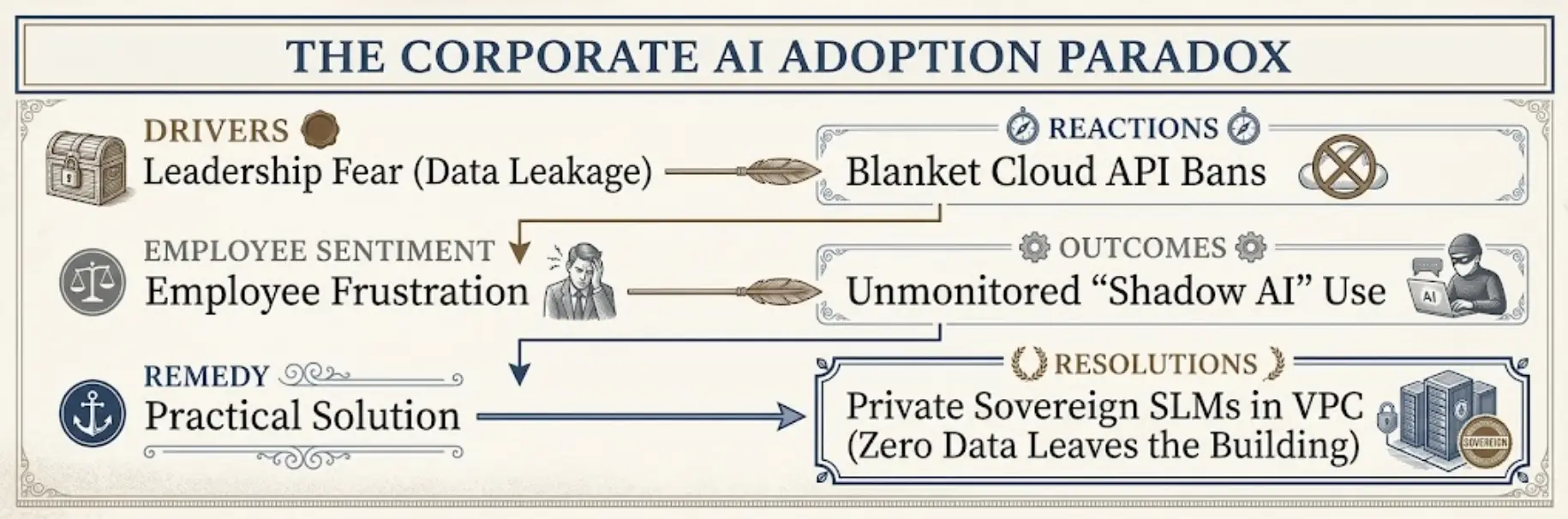
Challenge 1: The Fear of Being Wrong Outweighs the Desire to Innovate
In human psychology, the fear of making a visible mistake is always stronger than the excitement of winning. In a corporate environment, this dynamic is amplified tenfold:
A manager who boosts team efficiency by 20% using AI gets a brief nod in a quarterly review.
But if that same AI leaks a confidential customer contract or makes an embarrassing error in a regulatory filing, that manager's career could be derailed.
When leaders feel that kind of asymmetric risk, their natural reaction is to retreat to the safety of what they already know—even if it means staying stuck in slow, manual spreadsheets.
To solve this, leadership cannot simply issue policies telling staff to "be innovative." Leaders must remove the fear. The easiest way to remove the fear is architectural: ensure that proprietary data physically cannot leave the company's internal servers or private cloud.
Challenge 2: The Myth That Bigger Models Are Always Better
Many companies mistakenly believe they must connect to the biggest, most expensive commercial models to get real business value. In reality, massive generalist models are often expensive overkill for everyday corporate workflows.
On The TWIML AI Podcast [starting at 00:12:37], machine learning expert Hamel Husain shared how enterprise software company Honeycomb solved this dilemma:
"We were able to fine-tune a 7 billion parameter model to outperform GPT-3.5 on our specific query language... and now they offer that to enterprise clients without having to go through a complicated data privacy situation or SOC2 compliance."
By taking a compact, open-source Small Language Model (SLM) and training it specifically on their internal language, Honeycomb achieved three crucial wins:
Higher Accuracy: The model understood their internal jargon far better than generalist public models.
Zero Privacy Anxiety: The model runs inside their own private perimeter. Customer data never crosses the public internet.
Dramatically Lower Costs: Running a compact model locally costs a fraction of paying recurring per-token fees to cloud providers.
Challenge 3: Developer Friction and the Hidden Total Cost of Ownership
Even when companies decide to run private models, they often stumble during implementation because software engineers do not want to rewrite their existing applications.
As technical educator Matthew Berman [00:11:12] demonstrated, this hurdle has largely disappeared thanks to standardized local endpoints. Today’s private model engines run directly on corporate servers while mimicking the standard cloud APIs. An engineering team can redirect existing business tools to an internal, air-gapped model simply by changing a single line in a configuration file.
However, business leaders must manage the true Total Cost of Ownership (TCO), as outlined by Jon Whittle in AI for Business. While sovereign models eliminate third-party API bills, companies must budget for internal data cleaning, model testing, and staff training.
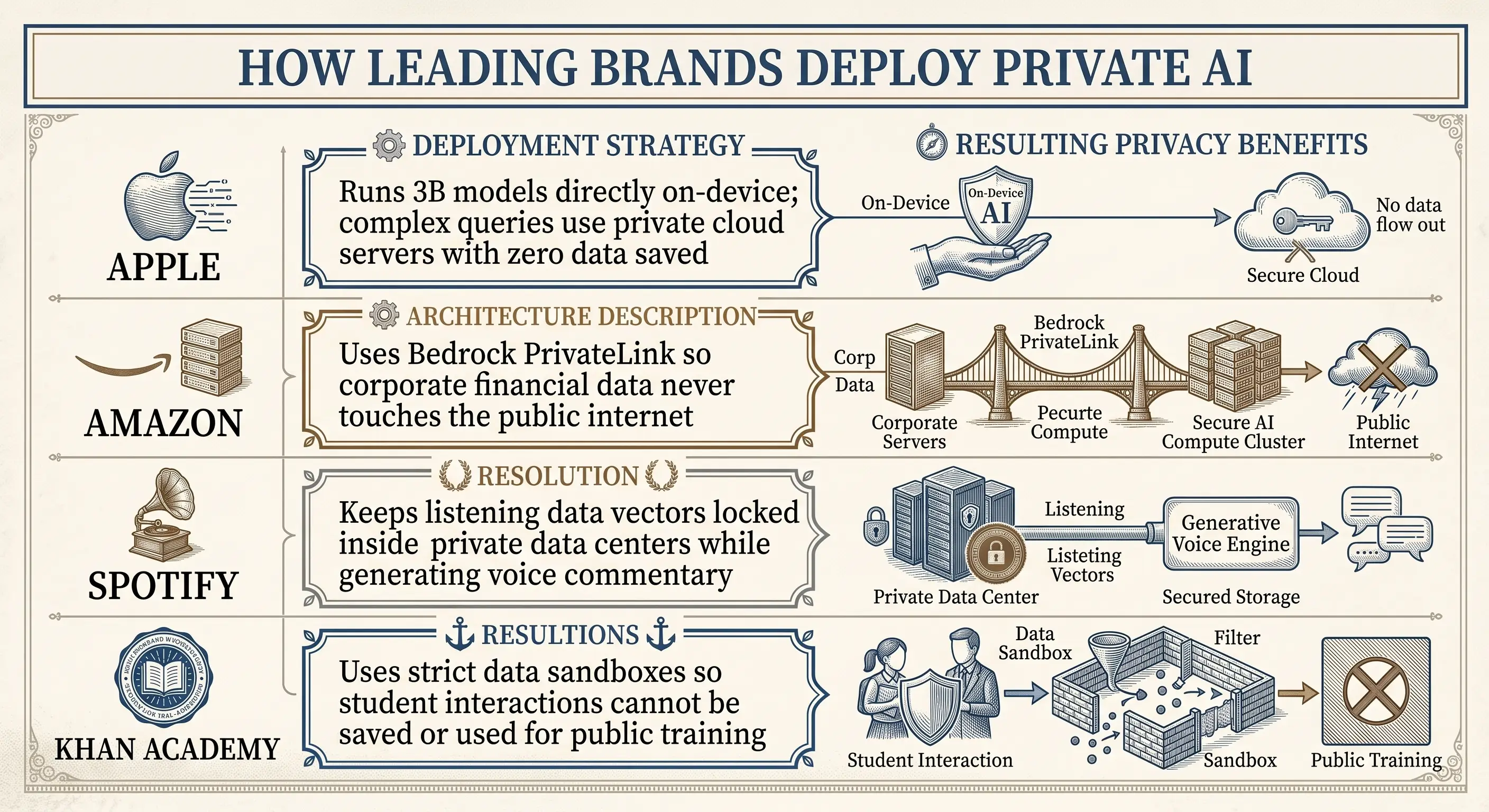
The Executive Playbook: What to Do on Monday Morning
To unlock your company's stalled AI projects without compromising security, execute these three practical steps:
Stop Banning AI and Start Providing Private Sandboxes: Company-wide bans only drive AI underground. Provide internal teams with a sanctioned, private environment where they can test tools freely without corporate data leaving the perimeter.
Right-Size the Solution: Identify your top 2–3 high-volume internal tasks (e.g., summarizing support tickets, drafting standardized customer replies, or querying internal documentation). Fine-tune an open-source 7B or 8B model specifically for those tasks instead of paying for giant generalist models.
Bridge the Gap Between Tech and Business: As recommended by Thomas Davenport and Nitin Mittal in All-In on AI, appoint a dedicated "business translator" who understands your legal constraints and can help data teams build compliant, production-ready workflows.
Questions & answers
- Why are our internal AI projects stuck in endless legal and security reviews?
- Projects stall because legal and security teams operate under strong risk aversion: a single data breach or regulatory fine can severely harm a company, while the upside of a 20% productivity gain feels abstract. When software sends confidential data to public cloud vendors, risk teams naturally say no. The fastest way to get approval is to deploy sovereign models that run strictly inside your own private corporate network.
- Is it really cheaper to run our own private AI models instead of paying cloud subscriptions?
- Yes, for high-volume, specific tasks. While public cloud APIs seem cheap initially, recurring token fees add up rapidly as thousands of employees use the system. Fine-tuning a smaller, open-source model eliminates variable usage fees. However, leaders must budget for internal data cleaning and routine maintenance to keep the model running smoothly.
- How do we prevent employees from secretly using consumer AI tools on personal devices?
- Company-wide bans never work; they only force staff to use unsanctioned tools secretly. The only effective solution is to provide employees with an approved, easy-to-use internal AI tool that matches the convenience of consumer apps while guaranteeing that all corporate data remains strictly protected inside your company firewall.