15 August 2026
Enterprise Agentic AI: Overcoming the Human Bottleneck
Across boardrooms and innovation labs, the narrative surrounding enterprise artificial intelligence has reached an inflection point. While algorithmic benchmarks continue their upward climb, chief digital officers and enterprise strategists face a sobering reality: over 70% of enterprise AI initiatives stall in "pilot purgatory," delivering negligible top-line expansion. The root obstacle is rarely computational capacity or model architecture. It is organizational architecture and human cognitive friction.

Scaling enterprise Agentic AI requires shifting focus from model capabilities to organizational operating models. By replacing monolithic LLMs with specialized Small Language Models (SLMs) and allocating ideation, screening, and validation tasks across human-in-the-loop governance gates, market leaders like SAP, Amazon, and Spotify convert fragmented pilots into measurable financial returns.
The Cognitive Bottleneck: Why Compute Cannot Fix Org Design
According to foundational research from Harvard Business School: Innovating with Generative AI, generative and agentic AI systems act unevenly across the corporate innovation lifecycle. While automated agents compress ideation costs to near-zero, unchecked deployments trigger acute human bottlenecks:
Fluency Bias & Idea Flooding: Hyper-fluent AI drafts trigger evaluative fatigue, forcing review committees to default to conservative, novelty-averse heuristics.
Mode Collapse & Homogenization: Teams querying identical foundation models converge on standard solutions, stripping brand offerings of distinctiveness.
The Authenticity Deficit: Synthetic consumer simulations recover statistical averages but fail to predict irrational human behaviors such as loss aversion and tacit emotional needs.
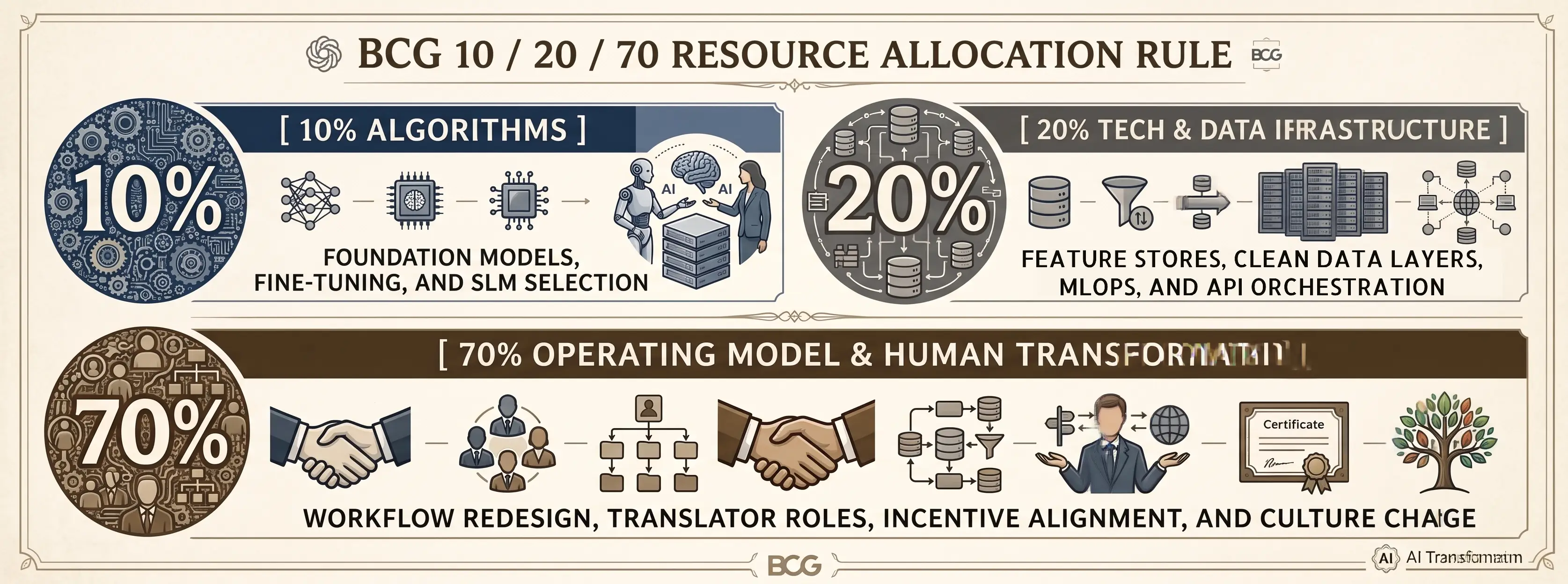
As established by the BCG Henderson Institute AI Research, enterprise success follows a strict 10/20/70 rule: only 10% of the effort lies in algorithmic selection and 20% in tech infrastructure, while 70% depends on operating model transformation, role redesign, and human change management.
Architectural Decoupling: Monoliths vs. Specialized SLMs
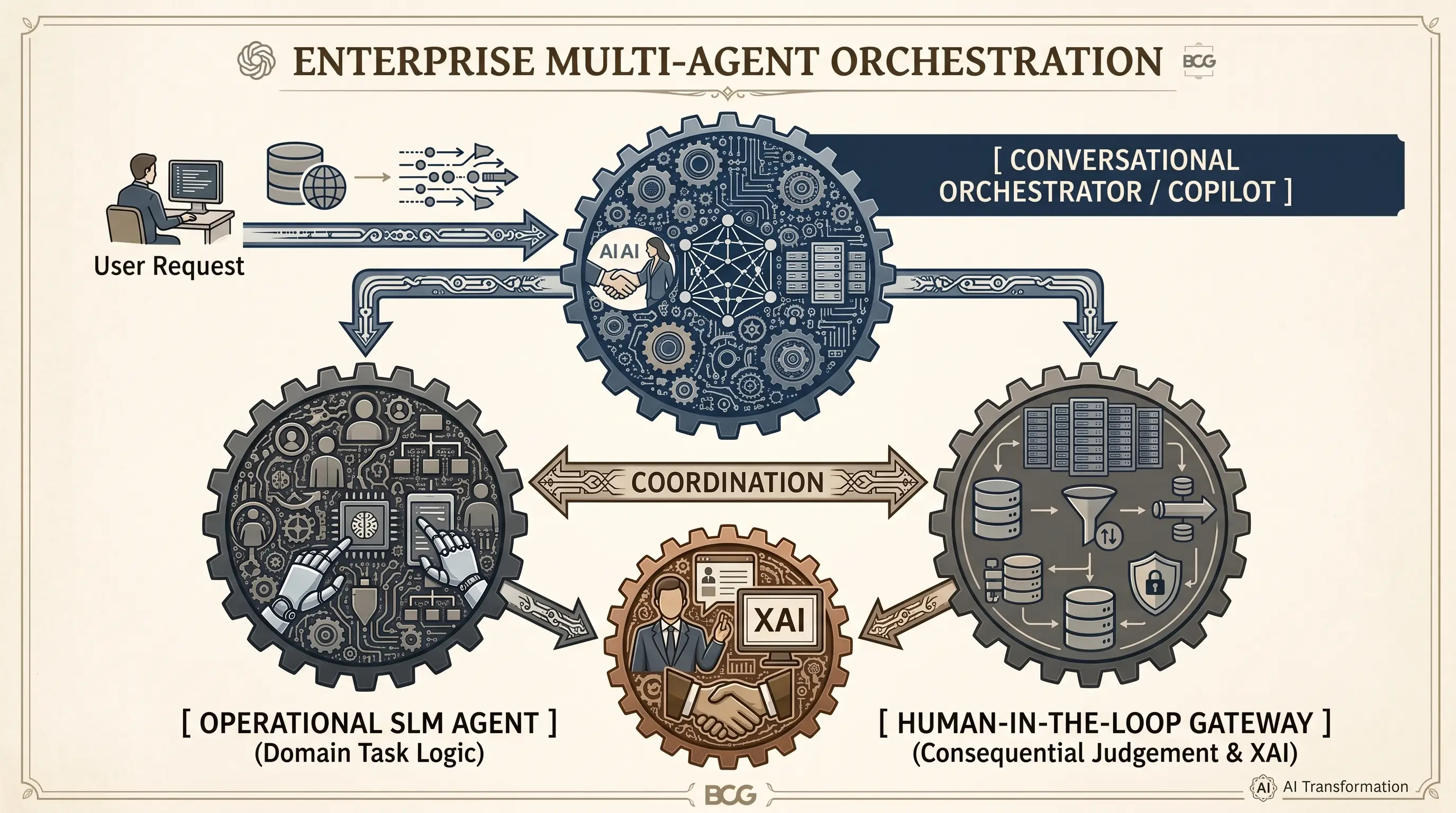
Leading organizations are abandoning single generalist LLM monoliths in favor of orchestrated multi-agent ecosystems governed by open standards like the Model Context Protocol (MCP). Instead of routing sensitive enterprise transactions through opaque 100-billion-parameter models, firms deploy task-specific Small Language Models (SLMs) bounded by strict business rules:
Spotify AI DJ: Deploys a three-layer pipeline combining deep reinforcement learning for tabular recommendation graphs, targeted LLMs for dynamic cultural commentary, and voice synthesis—coupled with human music editors governing boundary transitions.
Amazon Bedrock & Rufus: Combines Graph-RAG over product catalogs with autonomous robotic orchestration across fulfillment networks to execute multi-agent logistical routing in milliseconds.
Apple Intelligence & Private Cloud Compute: Implements an edge-cloud hybrid model where on-device 3B-parameter SLMs handle sub-second semantic queries, while cryptographically isolated cloud nodes process heavy computational loads without data retention.
Netflix Studio Production Guidelines: Utilizes computer vision to render hyper-personalized thumbnail art while enforcing strict provenance logging to protect intellectual property.
Nike A.I.R. Co-Design: Merges athlete biometric telemetry with parametric generative algorithms to fabricate custom 3D footwear prototypes in hours rather than months.
Social Impact & Non-Profit Deployments
Agentic architectures are simultaneously transforming the non-profit and public sectors:
Khan Academy Khanmigo: Operates an autonomous Socratic state machine that scaffolds problem-solving without leaking direct answers to students.
Charity: water IoT Telemetry: Deploys machine learning models over rural hand-pump vibration and flow sensors, predicting mechanical failure anomalies before communities lose water access.
World Wildlife Fund (WWF): Deploys edge bioacoustic vision agents across dense rainforests to autonomously isolate chainsaw acoustic signatures and dispatch rangers against illegal deforestation.
Strategic Roadmap: From Science Project to Balance-Sheet ROI
To transition from ad-hoc experimentation to Davenport & Mittal's AI-Fueled maturity benchmark (All-In on AI, Thomas H. Davenport, Nitin Mittal), leaders must execute Hassan Osman's structured 9-step transformation methodology (AI Change Management Made Simple, Hassan Osman):
Appoint Dedicated Business Translators: Embed quantitative domain translators at a strict 1:2 ratio with data scientists to bridge strategic commercial intent and model development.
Enforce Four-Tier Governance Guardrails: Establish non-negotiable strategic, technical, ethical, and legal guardrails (AI Governance Handbook, Gregory & Sircar, Springer 2025) with explicit Human-in-the-Loop (HITL) triggers for high-stakes decisions.
Concentrate Capital on Core Workflows: Cease funding dozens of disconnected $5,000 pilots. Concentrate resources into 2–3 high-leverage business processes where outcome-based ROI can be verified.
Additional Sources Breakdown:
Podcast: Me, Myself, and AI (MIT SMR & BCG)
Hosts: Sam Ransbotham & Shervin Khodabandeh
Episode: Building Better Answers With AI Agents: SAP's Walter Sun
Guest: Dr. Walter Sun, Global Head of AI, SAP
Executive Summary: SAP outlines why enterprise advantage does not stem from building in-house LLMs. Instead, SAP connects client ERP systems to 30+ dynamic foundation models via a centralized Generative AI Hub, orchestrating domain-specific Small Language Models (SLMs) through its Joule copilot.
Timestamped Highlights:
• Avoiding Generalist Monoliths: Dynamic benchmarking across third-party models sorts tasks by price and inference latency.
• The Efficiency of Fine-Tuned SLMs: Why smaller, task-bounded models outperform massive LLMs in enterprise accuracy while slashing compute overhead.
• Multi-Agent Delegation: How Joule delegates structured context across autonomous procurement, travel, and HR sub-agents.
• Tabular Foundation Models: Training transformer architectures on proprietary enterprise ERP and supply chain tables to predict shipping anomalies.
Podcast: Enterprise AI Innovators (Abnormal AI & Greylock)
Hosts: Evan Reiser & Saam Motamedi
Episode: Moving AI from Pilots to ROI with FICO CIO Mike Trkay
Guest: Mike Trkay, Chief Information Officer at FICO
Executive Summary: FICO's CIO details the transition from diffuse AI experimentation to capital concentration. He emphasizes domain-specific terminology mapping over raw LLM size and addresses shadow AI by providing compliant enterprise sandboxes.
Timestamped Highlights:
• Pilot Pruning: Shifting capital allocation from thousands of micro-experiments to two high-leverage workflows.
• Eliminating Lexical Ambiguity: Why generalist models fail in regulated credit decisioning and how domain models prevent semantic drift.
• Shadow AI Containment: Establishing sanctioned enterprise AI environments rather than issuing ineffective corporate bans.
Questions & answers
- Why do most enterprise Generative and Agentic AI pilots fail to achieve commercial scale?
- Enterprise AI pilots fail predominantly due to organizational and cognitive bottlenecks rather than algorithmic limitations. According to BCG and Harvard Business School research, 70% of transformation success relies on business process redesign, workforce upskilling, and dedicated business translators who map technical outputs to commercial KPIs. Without disciplined change management, companies suffer from idea flooding, evaluation fatigue, and uncoordinated shadow AI.
- How do Small Language Models (SLMs) outperform monolithic LLMs in enterprise production?
- Specialized Small Language Models (SLMs) outperform generalist monoliths in enterprise settings by offering higher factual precision within bounded domains, sub-second inference speeds, reduced hallucination rates, and up to 90% lower compute costs. When orchestrated in multi-agent networks, fine-tuned SLMs handle domain-specific workflows without exposing sensitive proprietary data or suffering from lexical ambiguity.
- How should enterprise leaders allocate decision rights between AI agents and human teams?
- Decision rights must be allocated based on risk reversibility and domain context. High-frequency, reversible tasks (e.g., initial research triage, anomaly detection, draft generation) can operate under Human-on-the-Loop (HOTL) supervisory telemetry. In contrast, irreversible, consequential, or regulated decisions (e.g., credit approval, legal agreements, clinical actions) require strict Human-in-the-Loop (HITL) verification gates with full explainability (XAI).