16 September 2026
Beyond Techne: Why Physical AI Needs Practical Wisdom
Enterprise Physical AI succeeds when organizations anchor autonomous algorithms into a unified, proprietary operational data foundation rather than deploying generic commercial models. By combining centralized telemetry, in-cab operator guidance, and human-in-the-loop validation checkpoints, industrial market leaders cut pilot deployment timelines by 75% and convert complex field operations into measurable bottom-line value.

Beyond Techne: Why Physical AI Demands Practical Wisdom
Across global enterprises, a profound divergence is underway in late 2026. According to recent cross-industry benchmarks, over 97% of enterprise executives have deployed artificial intelligence agents across their business units, with more than half of their workforce using AI weekly. Yet paradoxically, nearly 80% of organizations admit they are struggling to convert these deployments into measurable balance-sheet return on investment.
The root cause is an ancient intellectual trap. Two thousand four hundred years ago, Aristotle drew a sharp boundary between Techne (craft, technical skill, and the creation of tools) and Phronesis (practical wisdom, contextual judgment, and the ethical ability to act rightly in dynamic circumstances).
Most corporate AI initiatives remain trapped entirely in techne. Leaders purchase commercial foundation models, spin up isolated chatbots, and hand employees empty text prompts. But when automated agents confront the messy, physical reality of customer operations, equipment wear, legacy machinery, and complex commercial proposals, isolated algorithms stumble.
Sustainable enterprise scaling occurs only when organizations elevate AI from raw techne into systemic phronesis—embedding domain-specific intelligence directly into the physical workflows where human operators make consequential decisions.
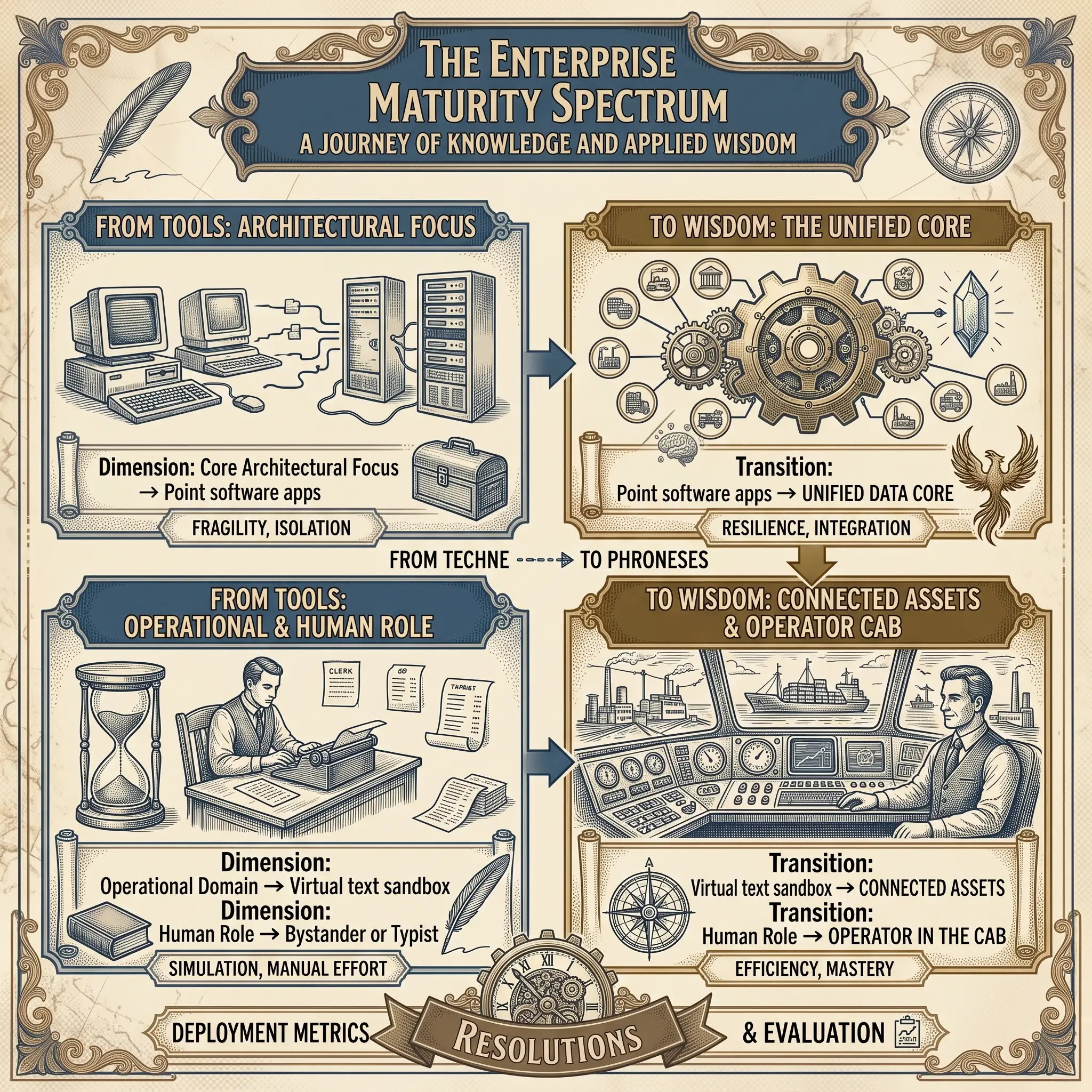
Challenge 1: The Illusion of the Surface (Plato's Cave in the Boardroom)
In Plato’s famous allegory of the cave, prisoners mistake flickering shadows on the wall for real physical objects. In enterprise technology, executives frequently commit the same perceptual error: they watch a vendor demonstrate a slick conversational chatbot on clean benchmark data, assume the problem of enterprise intelligence is solved, and order immediate departmental rollouts.
When those models hit live operations, the illusions dissolve:
A generic model has no awareness of equipment maintenance histories spanning decades.
It cannot reconcile conflicting telemetry streaming off field sensors in high-vibration, high-dust environments.
Confronted with a 300-page request for proposal (RFP) containing strict municipal compliance codes, generalist models generate convincing hallucinations that expose the firm to immense contractual liability.
The Solution: Build from the operational ground up. As Caterpillar Chief Digital Officer Ogi Redzic revealed on Enterprise AI Innovators, Caterpillar did not start with generative chatbots. They spent years building Helios, a centralized operational platform aggregating data from 1.6 million connected machines operating across global construction, mining, and energy sites.
Because that unified operational foundation was already built, Caterpillar launched the Cat AI Assistant in just ten months. The tool operates across 55 languages, coaches heavy-machinery operators directly inside the physical machine cab, and puts 50,000 service manuals—covering equipment built as far back as 56 years ago—directly into the hands of field technicians.
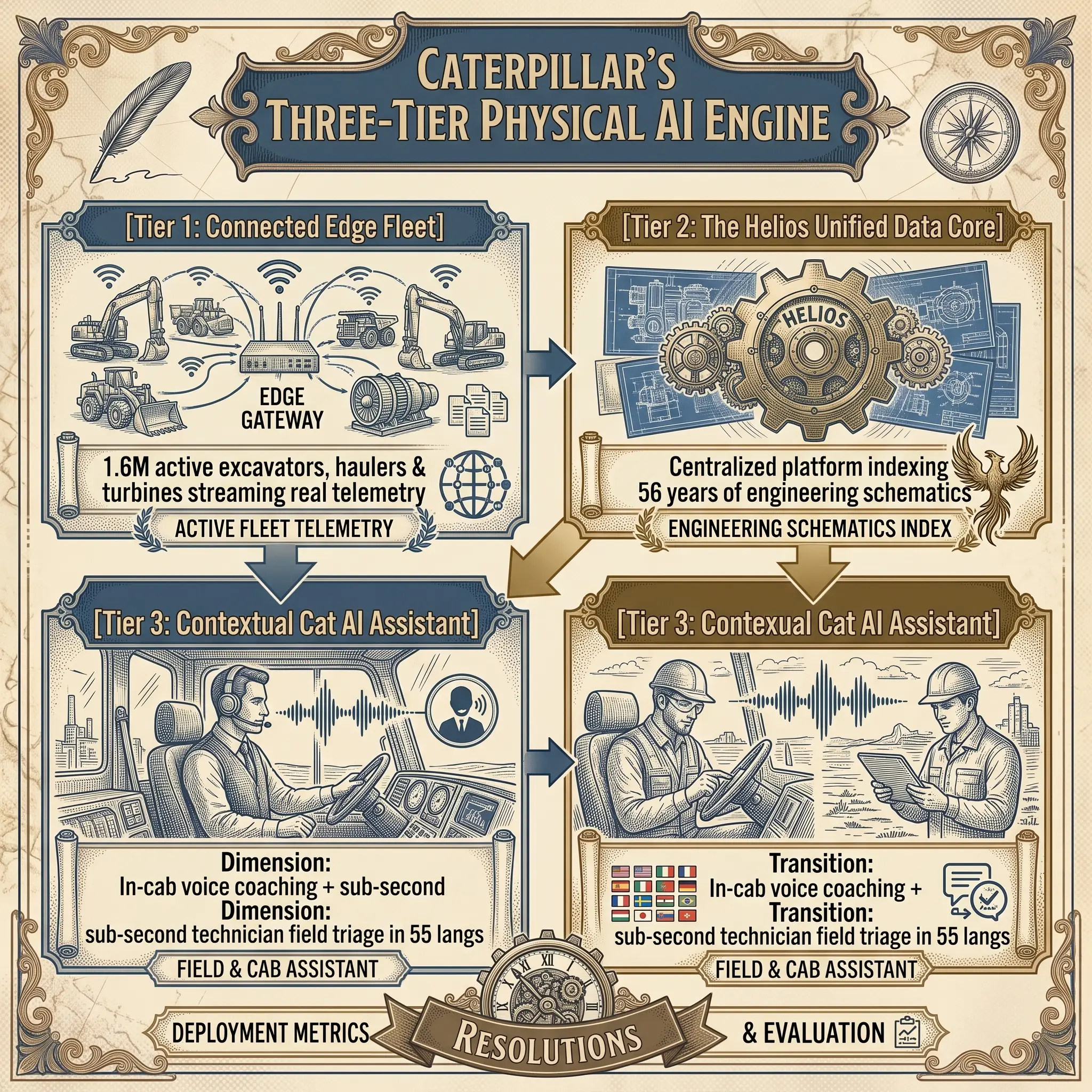
Challenge 2: Heraclitus on Flux—Why Static Prompting Breaks in Dynamic Workflows
The pre-Socratic philosopher Heraclitus noted that "You cannot step into the same river twice, for other waters are continually flowing on."
Business operations are not static document libraries; they are turbulent rivers. A building technology manufacturer like Johnson Controls manages complex HVAC, fire suppression, and building controls for thousands of landmark hospitals, skyscrapers, and data centers. No two buildings, engineering codes, or procurement bids are identical.
When organizations try to automate complex commercial bids by simply pasting text into third-party chat windows, the workflow stalls because single-shot prompts cannot navigate multi-variable engineering constraints.
The Solution: As Johnson Controls Chief Digital & Information Officer Vijay Sankaran detailed on Enterprise AI Innovators, they completely re-engineered commercial workflows using bounded agentic architecture:
Instead of forcing sales engineers to read 300-page tender documents manually, specialized agents ingest the technical specifications, isolate mechanical requirements, and automatically configure custom pricing tools exposed as standardized Model Context Protocol (MCP) endpoints.
Rather than outsourcing development to external systems integrators, Johnson Controls insourced their digital capability from 30% to 70% internal staff over 18 months, giving internal teams the deep operational fluency required to build bespoke agentic workflows at a fraction of vendor cost.
Challenge 3: Closing the "Responsibility Gap" with Human-in-the-Loop Governance
When a physical machine or commercial contract fails, algorithms cannot stand in court, negotiate with an insurer, or take accountability before a board of directors.
In the newly published academic volume Human-AI Interaction and Collaboration (Cambridge University Press, 2026), information scientists Dan Wu and Shaobo Liang warn against the Responsibility Gap: the dangerous ambiguity that arises when leaders delegate decision-making authority to autonomous systems without establishing clear human ownership.
When an industrial arm or heavy excavator is directed by software, algorithmic hallucinations don't just produce awkward text—they damage physical assets and endanger personnel. Sustainable scaling demands that the human operator in the cab or the certified engineer on the shop floor retains final supervisory override.
The Executive Playbook: Moving from Techne to Phronesis
To convert AI investments into tangible enterprise EBITDA, C-suite leaders must execute four disciplined maneuvers:
Consolidate Before You Generate: Stop funding isolated departmental generative experiments. Invest capital into centralizing your operational data—your equipment histories, service manuals, customer logs, and telemetry—into a unified data layer before rolling out AI interfaces.
Insource Your Strategic Digital Core: Follow Johnson Controls' model. Relying entirely on external consultants prevents your organization from accumulating domain expertise. Build an internal capability where your engineers understand both the physical equipment and the AI code.
Equip the Operator, Don't Erase Them: Follow Caterpillar's philosophy. The goal is not an unmanned bulldozer; it is putting an AI assistant inside the cab so a novice equipment operator performs with the precision of a thirty-year veteran.
Enforce the 10/20/70 Discipline: Strictly audit your AI budget. If you are spending 80% of your capital on software licenses and cloud compute while starving workforce upskilling and process redesign, your deployment will fail. 70% of capital belongs in human enablement.
Questions & answers
- Why do our commercial generative AI pilots fail to deliver measurable ROI?
- Most pilots fail because they focus on generic techne (deploying chatbot interfaces) rather than solving specific operational bottlenecks. Generic models lack access to proprietary telemetry, historical maintenance logs, and structured pricing rules. To achieve measurable ROI, organizations must follow Caterpillar’s blueprint: unify proprietary data into a centralized core (such as Helios) and build bounded, task-specific agents that automate high-friction workflows like technical RFP parsing or equipment troubleshooting.
- How can an industrial company automate legacy equipment that lacks modern IoT sensors?
- You do not need to replace every machine to benefit from AI. As demonstrated by Caterpillar’s support system covering equipment built as far back as 56 years ago, companies can digitize and index historical paper schematics, maintenance bulletins, and repair records into vector retrieval systems. Equipping frontline technicians with AI assistants that query this historical corpus cuts diagnostic downtime on legacy assets without requiring costly retrofits.
- Why is insourcing software capability becoming a priority for legacy industrial firms?
- Relying entirely on third-party systems integrators creates vendor lock-in, inflated consulting costs, and an inability to iterate rapidly. As demonstrated by Johnson Controls shifting from 30% to 70% internal technical staffing, having in-house developers who deeply understand both physical equipment and software architectures allows enterprises to build custom agentic pipelines at a fraction of third-party expense while retaining proprietary IP.